
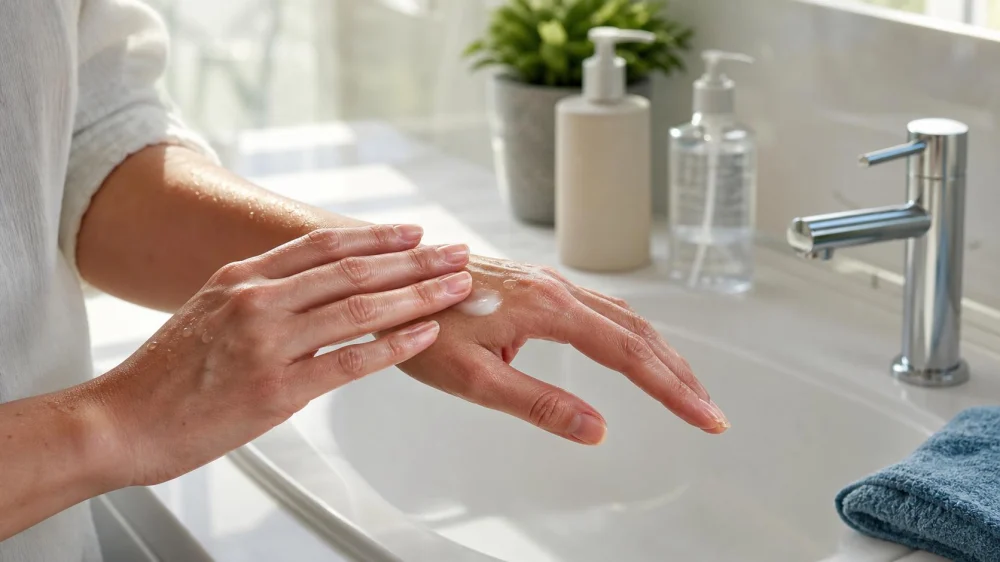
Hand Skin Care After Frequent Washing and Sanitizer
On this page
Quick answer
Do not cut back on hand hygiene just because your hands feel dry. Wash with soap and lukewarm water when indicated, pat rather than rub, and apply a fragrance-free cream or ointment while skin is still slightly damp. When sanitizer is appropriate, use a product with at least 60% alcohol, cover every surface until dry, then moisturize. Seek professional help for persistent rash, deep cracks, drainage, spreading redness, or work-limiting pain.
Hand barrier care is the routine of reducing unnecessary irritation while maintaining effective hand hygiene and replacing moisture after washing or sanitizer use. It supports the outer skin barrier; it does not replace infection-control rules or treat every cause of hand dermatitis.
Why frequent cleaning can dry hands
Soap, detergent, water exposure, friction, low humidity, and some sanitizer ingredients can remove or disrupt oils at the skin surface. Dryness may first appear as tightness, roughness, fine scale, itching, or stinging. With ongoing exposure, the skin can crack or bleed.
Not every hand rash is simple dryness. Irritant contact dermatitis results from repeated damage, while allergic contact dermatitis is an immune reaction to an ingredient such as fragrance, preservative, rubber additive, or workplace chemical. Atopic dermatitis, psoriasis, fungal infection, and other conditions can also affect the hands. Appearance alone may not separate them reliably.
Keep a short exposure log if the problem repeats. Note soap, sanitizer, moisturizer, gloves, cleaning chemicals, wet work, hobbies, rings, symptom location, and timing. A pattern can help a dermatologist or occupational-health professional identify what needs testing or substitution.
Wash effectively but gently
The American Academy of Dermatology advises washing with lukewarm water and cleaning all parts of the hands for at least 20 seconds. Gentle technique protects skin without shortening the wash.
- Remove rings when practical and permitted. Soap and water trapped underneath can prolong irritation. Store jewelry safely.
- Use lukewarm water. Hot water is not needed for routine handwashing and can worsen dryness.
- Apply enough soap. Cover palms, backs of hands, fingers, between fingers, thumbs, fingertips, and around nails.
- Rinse completely. Residual cleanser can continue to irritate.
- Pat dry with a clean towel. Avoid vigorous rubbing; leave skin slightly damp if you can moisturize immediately.
- Apply moisturizer. Work it over the backs, palms, fingers, fingertips, and around nails.
Use soap and water whenever public-health or workplace guidance calls for it, including when hands are visibly dirty or greasy. Do not substitute cleansing wipes, moisturizer, or gloves for a required wash.
Use hand sanitizer correctly
The US Centers for Disease Control and Prevention recommends an alcohol-based hand sanitizer containing at least 60% alcohol when soap and water are not available and sanitizer is appropriate for the situation. Apply the label-directed amount, cover all hand surfaces, and rub until dry. Do not rinse or wipe it off early.
Sanitizer does not remove every germ or harmful chemical and works less effectively on visibly dirty or greasy hands. Soap and water is better in certain situations identified by the CDC and workplace infection-control plan.
Allow sanitizer to dry completely before applying moisturizer, handling a flame, cooking, or putting on gloves. Alcohol-based products are flammable while wet. Supervise children to prevent swallowing and keep containers out of reach.
The AAD recommends applying hand cream or ointment after sanitizer has dried. Moisturizing does not undo hand cleaning. If a particular product consistently causes burning, rash, or swelling, stop that nonessential product, document the label, and seek advice about an alternative that still meets hygiene requirements.
Moisturize at the useful times
Apply moisturizer after each wash, after sanitizer dries, whenever hands feel dry, and before bed. The after-wash application is especially useful because cream or ointment helps hold water in slightly damp skin.
- Daytime: carry a tube that is easy to use after every cleaning event.
- Before work: use only a product compatible with required gloves, equipment, food handling, and clinical policies.
- After work: wash away occupational residue as directed, then moisturize.
- Bedtime: a thicker fragrance-free cream or ointment may be practical because there is time for it to absorb.
Clean reusable applicators and do not share tubs in settings where contamination is a concern. A personal squeeze tube can reduce repeated hand contact with the product. Do not put moisturizer directly into an open crack that appears infected unless a clinician says it is appropriate.
Choose and test products
For dry, chapped hands, the AAD notes that thick creams or ointments containing ingredients such as mineral oil or petrolatum often feel less irritating and that “fragrance-free” and dye-free products may be useful. “Unscented” can still contain fragrance-masking ingredients.
- Prefer fragrance-free over a strongly scented product.
- Choose a cream or ointment rather than a thin lotion when dryness is substantial.
- Look for a tube or tub when a thicker texture is needed.
- Check the full ingredient list if you have known allergies.
- Test a small area for several uses before applying widely when skin is reactive.
- Stop if a product repeatedly causes burning, swelling, blistering, or worsening rash.
A product that stings is not necessarily “working.” Severely cracked skin can sting with many products, but persistent burning or worsening deserves evaluation. Avoid adding several new soaps, sanitizers, and moisturizers at once because it becomes difficult to identify the trigger.
Adapt for work and glove use
Healthcare, food service, cleaning, childcare, manufacturing, and laboratory work may have specific hand-hygiene, lotion, nail, and glove rules. Follow the employer’s infection-control and chemical-safety program. Some lotions can interfere with glove integrity or clinical antiseptic products, so use only approved options at work.
Gloves protect against selected exposures but can also trap sweat and irritants. Wear the correct glove material and size for the task, change damaged or contaminated gloves, and remove them as trained. Hand hygiene may still be required before or after glove use.
- Do not wear wet gloves longer than necessary.
- Dry hands fully before donning gloves when the protocol allows.
- Do not put a glove over sanitizer that is still wet.
- Report recurring rash that follows a specific glove or workplace product.
- Use cotton liners only when safety policy and task allow them.
- Ask occupational health about product substitutions rather than bypassing required hygiene.
Warning signs and care boundaries
Schedule a dermatology or primary-care evaluation when dryness persists despite a gentle routine, keeps returning, affects sleep or work, or requires you to avoid necessary hand hygiene. A clinician can distinguish dryness from eczema, allergy, psoriasis, infection, and other causes and may recommend prescription treatment or patch testing.
Seek prompt care for increasing pain, warmth, swelling, spreading redness, pus or drainage, yellow crust, red streaks, fever, rapidly worsening cracks, or a painful area around a nail. People with diabetes, poor circulation, immune suppression, or a history of serious skin infection should ask a clinician for a lower threshold to seek care.
Call 911 in the United States for trouble breathing, facial or throat swelling, fainting, or another severe allergic reaction. For a chemical exposure, follow the product safety instructions and contact the appropriate poison or emergency resource; do not neutralize chemicals on the skin with another chemical.
Evidence and limitations
The lukewarm-wash, gentle drying, immediate moisturizing, and product-selection guidance comes from the American Academy of Dermatology’s dry-hand guidance. The CDC hand-sanitizer guidance explains the 60% alcohol threshold, correct rubbing technique, and situations where sanitizer is not enough.
This article does not select a product for a diagnosed allergy, prescribe medication, or replace a workplace infection-control program. Skin condition, occupation, age, pregnancy, allergy history, and immune status can change the safest plan. A dermatologist, primary-care clinician, occupational-health service, and workplace safety team may all have roles.
Frequently asked questions
Should I wash my hands less often if they are cracked?
Do not skip hand hygiene that is needed for health, work, food safety, or exposure removal. Use gentler technique and moisturize after cleaning. Persistent or painful cracks need professional assessment and an adapted plan.
When should I moisturize after sanitizer?
Rub sanitizer across all hand surfaces until it is completely dry, then apply cream or ointment. Do not mix moisturizer into the sanitizer or wipe sanitizer off early.
Is lotion or ointment better for very dry hands?
Thicker creams and ointments generally hold moisture better than thin lotions and may be less irritating when fragrance-free. Choose a texture compatible with your work and ask a dermatologist when skin is severely cracked or reactive.
Can moisturizer make hand sanitizer stop working?
Use sanitizer exactly as directed and let it dry before moisturizing. In healthcare or other regulated work, use only facility-approved lotion because some ingredients may be incompatible with gloves or antiseptic products.
How do I know whether dryness is actually hand eczema?
Itching, repeated rash, blisters, thick scale, fissures, or a pattern linked to certain exposures can suggest dermatitis, but diagnosis requires a clinician. Photograph flares and bring product and glove names to the visit.
Next steps
Place a fragrance-free hand cream beside each handwashing area and carry a small tube with sanitizer. For one week, moisturize after every wash and after sanitizer dries while recording exposures and symptoms. If the skin is not clearly improving, or if cracks, drainage, spreading redness, or significant pain appears, arrange professional evaluation.



 Perfect Place Aesthetics5.0 (60 reviews)
 Fusion Spa4.0 (34 reviews)
 Michele Terese Beauty5.0 (71 reviews)
 Arrow Esthetics5.0 (4 reviews)
 My Skin Esthetics5.0 (10 reviews)
 The Skin Angel Aesthetics5.0 (14 reviews)
 How to Treat and Prevent Skin Infections
 How To Heal Sun Damage And How To Manage It
 How to Repair Rosacea in People with Combination Skin
 How to Treat Skin Discoloration with the Best Brightening Products
 Daily Skin Care Routine for Age Spots – Simple Steps for Healthy, Glowing Skin
 Effective Ways to Treat and Prevent Skin Pigmentation from Hormonal Changes