
Sunscreen Expiration and Storage: Check Before You Apply
On this page
Quick answer
Do not use sunscreen past its printed expiration date. The U.S. Food and Drug Administration says a sunscreen without an expiration date should be considered expired three years after purchase. Write the purchase date on the container, protect it from excessive heat and direct sun, and replace it when its age or storage history is uncertain.
Expiration is only one part of dependable sun protection. Choose broad-spectrum SPF 15 or higher as directed by FDA, apply the amount and timing on the Drug Facts label, reapply at least every two hours, and reapply after swimming or sweating according to the water-resistance statement. Clothing, shade, and limiting midday sun add protection.
Find and interpret the date
Look on the bottle crimp, tube seam, base, cap area, back label, and outer carton. The date may appear as EXP followed by a month and year. Do not confuse a lot or batch code with an expiration date. If the format is unclear, contact the manufacturer using the label’s information.
Keep the outer package if it holds the only readable date or Drug Facts panel. Transfer no sunscreen into an unmarked travel container unless you can preserve the product identity, directions, date, and safe-use information. Never mix old and new sunscreen in one bottle.
When buying, choose a package you can reasonably use before expiration. Check tamper evidence and make sure the cap, pump, or spray nozzle is intact.
What to do when there is no date
FDA explains that products without a printed expiration date should be treated as expired three years after purchase. Mark the purchase month and year with a permanent marker or a small label that does not cover Drug Facts or warnings. A phone receipt or cabinet inventory can provide backup.
The three-year rule assumes appropriate storage. A bottle repeatedly left in a hot vehicle, direct sun, or an unknown lost-and-found location may not be dependable even when it is newer. Replace it rather than guessing.
For a bottle received from someone else, ask when and where it was purchased and stored. Do not rely on smell or appearance alone to prove effectiveness.
Protect sunscreen from heat and sun
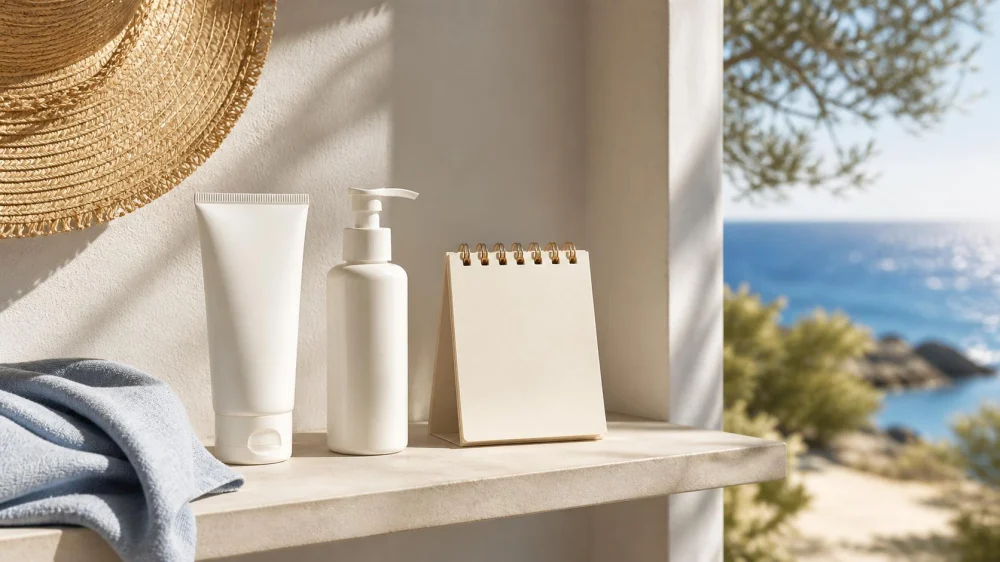
FDA advises protecting sunscreen containers from excessive heat and direct sunlight. At the beach or pool, keep the product in shade, wrap it in a towel, or place it in a cooler without letting it freeze or leak into food. Close the cap after each use.
A parked vehicle can become very hot. Use the sunscreen you need during the trip, then return it to a suitable indoor storage location instead of keeping it in a glove box or trunk for the season. Avoid windowsills, radiators, and outdoor storage bins.
Follow any temperature or storage statement on the specific label. Aerosol containers also carry flammability and pressure warnings; keep them away from flame, smoking, and high heat, and follow disposal directions.
Check the container and product
Before application, confirm the label is readable and the package has not leaked, cracked, rusted, swollen, or lost its cap. A damaged pump or clogged spray can prevent even application. Do not puncture or heat an aerosol container.
Replace sunscreen when color, odor, consistency, or separation has changed unexpectedly and does not resolve as the directions indicate. Grit, contamination, water inside the bottle, or product around a broken seal are reasons to discard it.
Wash or sanitize hands before handling the opening, avoid touching the nozzle to skin, and do not share a roll-on or applicator that directly contacts skin. Keep sand and pool water out of the container.
Build a reliable use routine
- Read the full Drug Facts label each season and whenever the product changes.
- Apply generously to exposed skin before sun exposure as the label directs.
- Use broad-spectrum protection and choose SPF based on labeled guidance and personal needs.
- Reapply at least every two hours and after towel drying.
- For swimming or sweating, use a water-resistant product and follow its 40- or 80-minute statement.
- Do not use sunscreen on damaged skin unless the label and a clinician say it is appropriate.
- Use protective clothing, a broad-brimmed hat, sunglasses, and shade.
Sprays require special attention to coverage and inhalation warnings. Do not spray directly into the face; apply to hands first if the label directs. Never spray near flame, heat, or while smoking.
When to replace it
Replace sunscreen when:
- the printed date has passed;
- three years have passed since purchase and no date is printed;
- purchase date or storage history is unknown;
- it spent extended time in excessive heat or direct sun;
- the package, seal, cap, pump, or nozzle is damaged;
- the product looks, smells, or behaves unusually; or
- a recall notice matches the exact product and lot.
Dispose of the product according to its label and local household-waste guidance. Do not pour large quantities into a storm drain or reuse a pressurized can.
Bag and cabinet checklist
- Check expiration or write the purchase date.
- Keep Drug Facts and lot information readable.
- Store tightly closed, away from heat and direct sun.
- Carry enough product for generous reapplication.
- Pack a hat, protective clothing, and sunglasses.
- Replace questionable bottles before a trip.
- Review water-resistance and spray warnings.
Frequently asked questions
Can I use sunscreen one month past expiration?
FDA advises not using sunscreen after its expiration date. Replace it.
Does unopened sunscreen still expire?
Yes. Use the printed date or the FDA three-year rule when no date is shown.
Can I keep sunscreen in the refrigerator?
Follow the product label. A cool indoor cabinet is usually simpler; avoid freezing and food contamination.
Is separation always a sign it is bad?
Some formulas direct shaking, but persistent or unusual separation deserves replacement or manufacturer guidance.
Does higher SPF last longer between applications?
No. Reapply at least every two hours and after swimming or sweating as labeled.
Can I identify potency by smell?
No. Odor cannot confirm sun-protection performance, age, or safe storage.
Sources and evidence notes
The U.S. Food and Drug Administration advises against using sunscreen after expiration, treats an undated product as expired three years after purchase, and recommends protecting containers from excessive heat and direct sun. See FDA sunscreen guidance.
The FDA sunscreen monograph includes labeling for reapplication, water resistance, and protection of the product from excessive heat and direct sun. Product-specific Drug Facts and warnings remain essential.
Conclusion and next steps
Check every sunscreen for a readable expiration or purchase date before relying on it. Replace expired, overheated, damaged, contaminated, or uncertain products. Store the replacement away from direct sun and excessive heat, apply and reapply exactly as labeled, and combine sunscreen with shade and protective clothing.



 The Melanated Esthi4.0 (14 reviews)
 Made In Miami MD4.0 (17 reviews)
 Johanna's Skin Care5.0 (5 reviews)
 Iuliana Skin Care Studio4.0 (97 reviews)
 DF - Skin Beauty Aesthetics Advanced5.0 (26 reviews)
 Invigorate Spa4.0 (329 reviews)
 How To Heal Your Redness With These 5 Tips | Expert Skincare Advice
 Effective Ways to Improve Your Dry Skin with These 12 Tips
 Common Mistakes in Using Chemical Exfoliants to Improve Redness
 How To Choose the Right Physical Exfoliants to Improve Scars
 How to Treat and Prevent Acne Scars with Consistent Skin Care
 How To Prevent Scars With A Simple Routine