
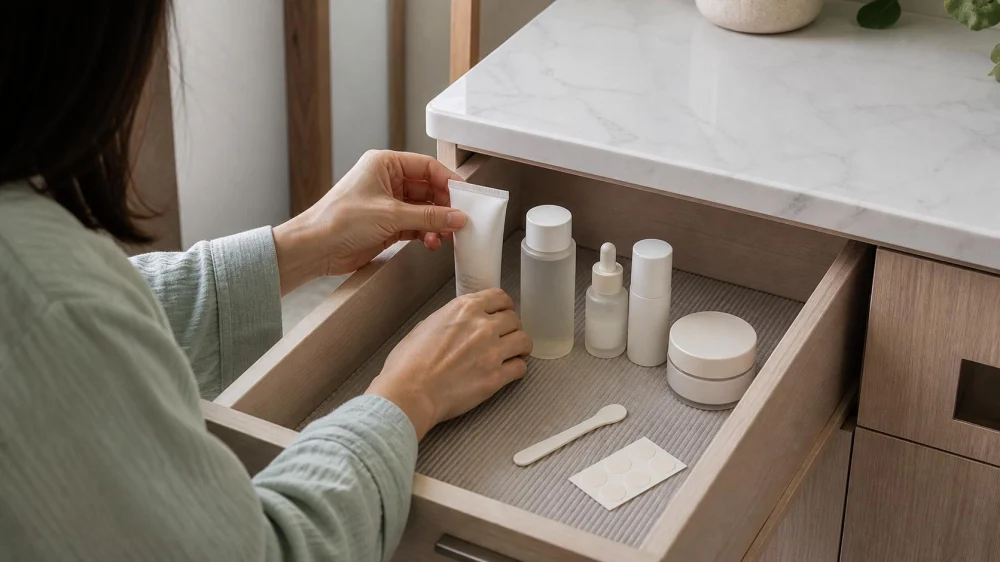
Skincare Storage: Heat, Light, Air, and Clean Handling
On this page
- Quick answer
- Why skincare storage matters
- Control heat and light
- Limit air, water, and contamination
- Use packaging as designed
- Track opening and label dates
- Pack skincare for travel
- Know when to stop using a product
- Limitations and safety notes
- Frequently asked questions
- Sources and evidence notes
- Conclusion and next steps
Quick answer
Store skincare in its original, tightly closed packaging at the temperature and light conditions on the label. A cool, dry cabinet outside direct sunlight and away from shower steam is a practical default. Keep wet fingers out of jars, clean applicators, record the opening date, and discard products with unexpected odor, color, texture, separation, damaged packaging, or contamination. Refrigerate only when instructed.
This guide is for consumers storing personal skincare products in the United States. Product labels and manufacturer instructions take priority because formulas, preservatives, packaging, and drug requirements differ.
Why skincare storage matters
Skincare storage is the combination of temperature, light, air exposure, moisture control, packaging, and handling that helps a product remain within its intended condition. Poor storage can change texture, odor, color, delivery, stability, or contamination risk.
A product can look normal while no longer meeting its labeled performance, and a visible change does not reveal the exact chemical cause. Storage cannot extend a product beyond manufacturer dating or restore a formula that has degraded.
Control heat and light
Direct sunlight, hot cars, windowsills, heating vents, and repeated temperature swings can stress formulas and packaging. Choose a consistent indoor location within the label’s stated conditions.
- Keep products away from sunny windows and radiators.
- Do not leave skincare in a parked vehicle.
- Avoid storing the main supply directly in a steamy shower area.
- Close drawers and cabinets to reduce light exposure.
- Do not freeze products unless the manufacturer specifically permits it.
“Cool” does not automatically mean refrigerated. Cold temperatures can thicken, separate, crystallize, or otherwise change some formulas. Follow the label.
Limit air, water, and contamination
Air exposure can affect ingredients and dry out formulas. Water introduced into a container can dilute the product and challenge its preservation system. Microbes can enter through fingers, shared tools, dirty caps, and repeated contact with skin.
- Replace caps immediately and tighten them without damaging threads.
- Use clean, dry hands or the provided applicator.
- Do not add water, toner, oil, fragrance, or another product to the original container.
- Wipe product residue from the outside of pumps and caps without pushing debris into openings.
- Do not share products that touch lips, eyes, irritated skin, or an applicator returned to the container.
- Keep products away from toilet splash zones and damp cleaning tools.
Use packaging as designed
Opaque bottles, airless pumps, tubes, droppers, jars, and single-dose containers control exposure differently. Moving a formula into a decorative container can remove light protection, introduce contamination, change dispensing, or separate it from safety information.
When a pump stops working, check the manufacturer’s troubleshooting instructions. Do not puncture a pressurized, airless, or sealed package. For jars, use the supplied spatula if provided and clean it according to instructions.
Keep the original box when it carries ingredient, drug-facts, lot, expiration, warning, or storage information not repeated on the container.
Track opening and label dates
- Find the printed date. Identify expiration, manufacturing, or other coded information without assuming what an unlabeled code means.
- Check the period-after-opening symbol. When present, it commonly shows a number of months after opening, but follow the specific label and market guidance.
- Write the opening date. Put it on removable tape or a household inventory rather than covering required label information.
- Keep the lot number. It helps identify a recall or report a problem.
- Review infrequently used products. Seasonal items and backups are easy to forget.
Do not use smell or appearance as the only dating system. Follow printed expiration and after-opening instructions, particularly for over-the-counter drug products such as sunscreens or acne treatments.
Pack skincare for travel
Take only the amount needed and choose leak-resistant travel containers compatible with the formula when decanting is allowed. Label every container clearly with product identity and use; do not rely on memory or similar colors.
Keep drug facts, directions, and warnings available. Protect products from checked-baggage temperature extremes, direct sun, and hot vehicles. Place containers in a sealed secondary bag and keep pumps from being pressed accidentally.
Do not return leftover decanted product to the original container. Wash and fully dry reusable travel containers before refilling, and avoid using a container whose prior contents are uncertain.
Know when to stop using a product
- the labeled expiration or period after opening has passed;
- odor, color, texture, thickness, or separation changes unexpectedly;
- the seal, pump, cap, or container is damaged;
- water, dirt, mold, or another product entered the container;
- the product was exposed to an unapproved temperature extreme;
- a recall matches the exact product and lot;
- the product causes a new significant reaction.
Do not taste a product to test it. Follow local disposal guidance and keep discarded products away from children and pets.
Limitations and safety notes
Homemade, preservative-free, and freshly compounded products may have different storage and dating requirements. Get written instructions from the maker, pharmacist, or clinician and do not extend use beyond them.
Contact a healthcare professional for persistent rash, blistering, facial or eye swelling, severe pain, signs of infection, or a reaction involving eyes, mouth, or breathing. Call emergency services for breathing difficulty or signs of a severe allergic reaction.
Frequently asked questions
Should skincare be stored in the bathroom?
A dry cabinet away from shower steam and heat may work when it meets the label conditions. A constantly warm, humid shelf is less suitable.
Does a skincare fridge make products last longer?
Not necessarily. Refrigerate only when the label or manufacturer instructs it. Cold can change some formulas and does not reset expiration.
Can I move products into clear travel jars?
Only when the formula permits decanting and the jar is clean, dry, compatible, and labeled. Light-sensitive or airless products may need original packaging.
What if a cream separates?
Check whether separation is expected and reversible according to the manufacturer. Unexpected persistent change after heat or age is a reason to stop and ask.
Sources and evidence notes
This guide reflects broad cosmetic and drug-product handling principles: temperature, light, air, water, packaging, and hygiene can affect product stability and contamination. Exact dating and storage come from the label and manufacturer; appearance alone cannot verify quality.
Conclusion and next steps
Move daily products to one cool, dry, shaded cabinet, keep them in original packaging, and record opening dates without covering labels. Clean applicators, close containers promptly, and review backups and travel sizes. When instructions, dates, or product changes are unclear, stop using the item until the manufacturer or a qualified professional can clarify.


 Skinatic Skincare4.0 (34 reviews)
 Jewel Skin Studio LLC5.0 (22 reviews)
 iGlow Skin Solutions0.0 (0 reviews)
 Imperium Beauty llc5.0 (1 reviews)
 Slim Thicc Body Sculpting5.0 (14 reviews)
 The Blue Room Face & Body5.0 (18 reviews)
 Whitehead Prevention and Treatment for Oily Skin
 How to Avoid Sun Damage and Keep Your Skin Healthy
 How to Get Rid of Clogged Pores and Blackheads with Simple Solutions
 Understanding Sun Damage For Women
 How to Deal with Dark Circles Using Natural Remedies
 How to Reduce Age Spots with a Simple Routine: Tips for Beautiful, Even Skin