
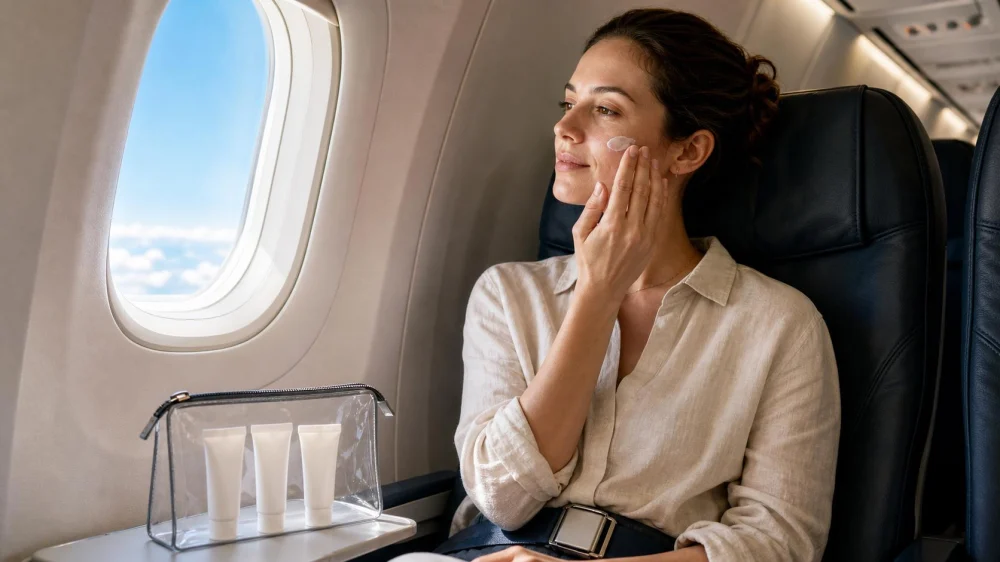
Skin Care for Air Travel: Keep a Simple In-Flight Routine
On this page
Quick answer
For air travel, keep skin care familiar and minimal: cleanse gently before departure, apply a moisturizer you already tolerate, use broad-spectrum sunscreen when sun exposure is expected, keep hands clean, and reapply moisturizer only when needed. Avoid trying new acids, peels, masks, or fragranced sprays in transit. After landing, cleanse gently and return to your usual routine.
An air-travel skin routine is a short plan for managing dryness, hygiene, sun exposure, and product access during a flight. It should protect the skin barrier without turning the cabin into a treatment room. People with eczema, severe acne, allergies, recent procedures, or prescription routines may need individualized advice.
What air travel changes
Aircraft cabins often feel dry, and travel adds handwashing, temperature changes, sleep disruption, close contact with shared surfaces, and long periods away from normal supplies. Skin may feel tight or lips may become dry even when the usual routine works well at home.
A flight does not automatically require extra exfoliation or a long list of products. Adding several unfamiliar actives can create irritation that is difficult to manage away from home. The most useful approach is to preserve the routine's basic functions with fewer items.
Prepare before the flight
- Check current travel rules. Confirm airport, airline, destination, and security restrictions for liquids, aerosols, medications, and container sizes.
- Choose familiar products. Pack a gentle cleanser, moisturizer, lip product, and sunscreen already tolerated by your skin.
- Use clear labels. Keep products in leak-resistant containers that identify the contents and do not resemble eye drops, medicine, or food.
- Protect the barrier. Cleanse without scrubbing and apply moisturizer before leaving for the airport.
- Plan for sun. Consider travel to and from the airport, window exposure, altitude, destination time, and outdoor plans when scheduling sunscreen.
- Pack prescriptions correctly. Keep original labels and follow storage instructions; ask the prescriber or pharmacist about time-zone changes.
Do not decant prescription creams into anonymous pots. If a product must remain cool or protected from light, obtain professional travel guidance rather than improvising with ice against the container.
A simple in-flight routine
- Clean your hands first. Use soap and water when available or an appropriate hand sanitizer, then let hands dry before touching the face.
- Blot rather than scrub. If skin becomes oily or sweaty, press with a clean tissue. Repeated cleansing can worsen dryness.
- Apply moisturizer selectively. Use a small amount on dry intact areas with clean hands. Avoid dipping used fingers repeatedly into a shared jar.
- Protect lips. Use a familiar lip balm and do not share it.
- Reapply sun protection when relevant. Follow the sunscreen label and account for window seating, daylight, and outdoor exposure after landing.
Skip sheet masks, facial misting, strong fragrances, and complicated tools. They can create mess, irritate skin, disturb nearby travelers, or introduce contamination. Cabin water and surfaces are not an ideal setup for multi-step facial care.
Reset after landing
Wash hands, then cleanse the face gently when you reach a suitable sink. Remove sunscreen, makeup, sweat, and travel residue without hot water or a scrub. Apply the familiar moisturizer and resume the normal schedule rather than trying to compensate with extra active ingredients.
If the skin feels irritated, simplify temporarily: gentle cleanser, moisturizer, and sunscreen for exposed skin. Pause optional exfoliants or fragranced products until comfort returns. Follow prescription instructions unless the prescriber has given a pause plan.
Launder reusable cloths and clean refillable containers before the next trip. Discard products that leaked, changed color or odor, lost their label, or were stored outside allowed conditions.
Pack products without mix-ups
- Use the smallest set that covers cleansing, moisturizing, lip care, sun protection, and prescriptions.
- Keep labels legible and include ingredient information for allergy-sensitive travelers.
- Place liquids in a sealed pouch away from electronics and clean tools.
- Use pumps or squeeze tubes when possible to reduce repeated finger contact.
- Carry enough for delays without bringing large open jars.
- Keep products out of direct sun, hot vehicles, and freezing baggage areas when labels warn against them.
- Do not share eye, lip, acne, or prescription products.
Air-travel skin checklist
- All products have been tolerated at home.
- Travel and security requirements are verified from current sources.
- Containers are sealed, labeled, and compatible with their contents.
- Prescription storage and time-zone instructions are clear.
- Hands are cleaned before touching skin or products.
- No strong fragrance, spray, or messy treatment affects other passengers.
- Sun protection covers the actual daylight and outdoor plan.
- A gentle reset routine is available after landing.
Limitations and medical triggers
Seek urgent medical help for breathing difficulty, widespread hives, swelling of the lips or tongue, blistering, severe pain, eye involvement, or a rapidly spreading reaction. Tell the crew if a serious reaction begins during a flight.
Contact a healthcare professional for persistent rash, oozing, infection signs, severe eczema flare, painful acne lesions, or a reaction that does not improve after stopping a suspected product. Travel stress can overlap with medical conditions that need more than moisturizer.
People with recent laser treatment, chemical peels, surgery, radiation, open wounds, severe allergies, or temperature-sensitive prescriptions should obtain a travel plan from their clinician. General skin-care advice cannot establish fitness to fly.
Sources and evidence notes
The guidance uses broad dermatology and travel-hygiene principles: maintain the skin barrier, reduce unnecessary product changes, clean hands before face contact, follow sunscreen labels, and protect prescription storage. It does not claim that cabin dryness causes a specific disease.
Use current airport and airline rules, product labels, prescription instructions, recognized dermatology guidance, and your licensed clinician as primary sources. Travel requirements can change, so verify them close to departure.
Frequently asked questions
Should I wear a sheet mask on a plane?
It is not necessary. A familiar moisturizer is simpler and less likely to drip, require disposal, or introduce a new ingredient. Avoid anything that interferes with safety instructions or nearby passengers.
Do I need sunscreen at an airplane window?
Sun exposure varies with seat, time, route, shade position, and cloud conditions. If meaningful daylight exposure is expected, use a broad-spectrum product according to its label and physical shade when available.
Can I use facial mist to prevent dryness?
Misting alone may not provide lasting comfort and can affect nearby travelers. A small amount of familiar moisturizer on clean skin is easier to control.
Should I stop acne treatment for a flight?
Do not change a prescription without the prescriber's plan. For nonprescription actives that frequently irritate you, ask a pharmacist or clinician how to schedule them around travel.
How do I handle a product leak?
Keep it away from eyes and shared surfaces, wash exposed skin if the label directs, seal the damaged item, and clean the pouch. Discard a product if contamination or container integrity is uncertain.
Conclusion and next steps
Test the travel version of your routine at home: cleanse, moisturize, protect lips, and apply sunscreen when needed using only the items in your pouch. If that simple plan works, resist adding last-minute products. Confirm travel rules, protect prescriptions, and return to the normal routine after landing.


 Skin Plus Acne Clinic5.0 (31 reviews)
 Advanced Nails and Spa4.0 (5 reviews)
 Skin By Yelena4.0 (14 reviews)
 Kel Aesthetics4.0 (96 reviews)
 Isabella Mia Skin Care4.0 (67 reviews)
 Starlight Clinical Spa0.0 (0 reviews)
 How to Protect Your Skin from Pollution and Other Environmental Damage
 How to Get Rid of Skin Tags: Treatment and Prevention Tips
 Skin Care Tips for Moisturizer to Improve Dark Spots
 Skin Care Tips for Facial Oils That Help Improve Large Pores
 How To Prevent Hyaluronic Acid From Causing Whiteheads
 How to Balance Dark Circles Using Natural Remedies