
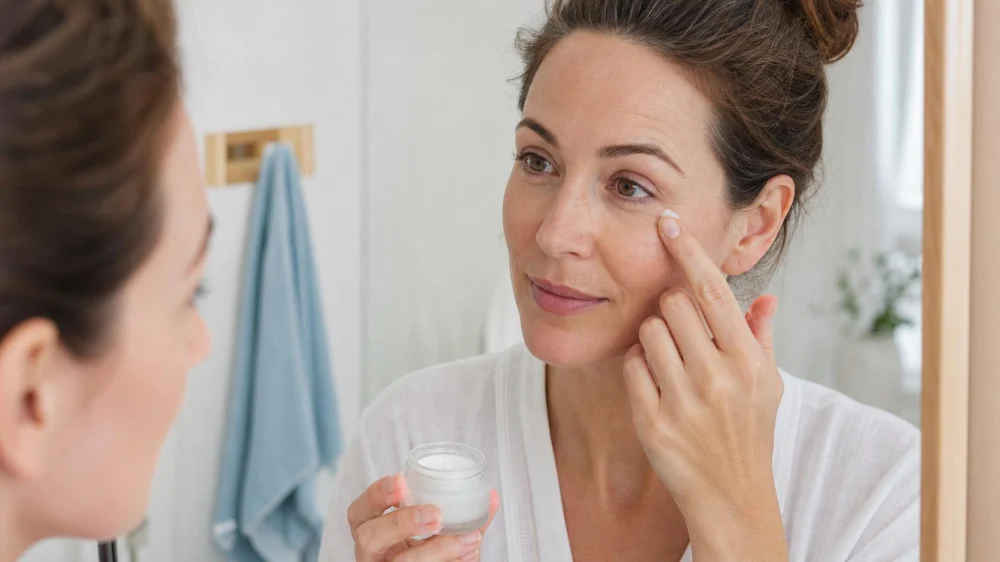
Eye-Area Skin Care: Apply Gently and Know When to Stop
On this page
Quick answer
Use only products whose directions allow application near the eyes, begin with a small amount, keep it off the lash line and out of the eye unless specifically labeled otherwise, and avoid rubbing or stretching skin. Add one product at a time. Stop for burning, swelling, rash, persistent tearing, or worsening redness, and seek prompt care for eye pain or vision changes.
This guide covers general cosmetic skin care around the eyes for adults in the United States. It does not diagnose eyelid disease, allergy, infection, injury, dry eye, or vision problems, and it does not replace label directions or professional care.
Why the eye area needs care
The eyelid and nearby skin are thin, mobile, and close to the ocular surface. Products can migrate with sweat, tears, rubbing, sleep, or layering. A formula tolerated on the cheek or forehead may sting the eye or irritate eyelid skin.
“Eye cream” is a product category, not a guarantee that every formula suits every person or every part of the eyelid. Fragrance, preservatives, active ingredients, adhesives, makeup, cleansers, and applicators can all be relevant to irritation.
Puffiness, dark appearance, fine lines, dryness, redness, and itching can have different causes. Skin care may change appearance or comfort but should not be treated as a diagnosis.
Read the product boundary
Check the intended use, eye-area warnings, application zone, frequency, sun precautions, storage, expiration, and what to do after accidental eye contact. A facial product that says “avoid eye area” should not be moved closer in hopes of stronger results.
Review the full ingredient list when you have known sensitivities. “Fragrance-free,” “unscented,” “natural,” “clean,” “hypoallergenic,” and “ophthalmologist tested” are not interchangeable and do not guarantee that a product will not irritate you.
Keep the original packaging so directions and lot information remain available. Do not transfer eye-area products into an unmarked jar or share them with another person.
Use a simple application routine
Wash and dry hands. Cleanse with a method suited to your skin and eye makeup, then pat rather than scrub. Dispense a small amount without touching the container opening to skin or lashes.
Apply along the bony orbital area or the exact zone stated on the label. Use light tapping or smoothing pressure and keep the product away from the eye opening, inner corner, lash roots, and waterline unless it is specifically intended there.
Allow one layer to settle before adding another. Too much product or many overlapping layers can increase migration, pilling, and difficulty identifying the irritant. Introduce one new product at a time and use it at the labeled frequency.
During daytime, use sun protection appropriate for the face and eye area. Sunglasses and a brim can supplement product-based protection. Avoid applying a sunscreen closer to the eyes than its directions permit.
Eye-area skin-care checklist
- Define the goal. Dryness, makeup removal, sun protection, and cosmetic appearance may need different products.
- Read the directions. Confirm the product is allowed near the eyes and identify the exact boundary.
- Check hygiene. Use clean hands, clean applicators, and uncontaminated packaging.
- Start with one change. Introduce a single product at low labeled frequency.
- Use a small amount. More product raises migration risk and rarely clarifies whether it helps.
- Keep distance from the eye. Follow the permitted application zone and avoid the waterline.
- Track the response. Note timing, side, burning, itching, swelling, scaling, tearing, and vision symptoms.
- Stop early. Remove the suspected product and seek appropriate advice rather than layering a second active to correct irritation.
What to do if irritation starts
Stop the suspected product. If it entered the eye, follow the label's first-aid directions and rinse as advised with clean water. Remove contact lenses only if this can be done safely and applicable guidance supports it.
Do not neutralize one product with another, scrub the eyelids, apply essential oils, or use leftover prescription eye or skin medication. Keep the container and ingredient list, and record when symptoms began and which products were used.
Mild skin irritation may improve after stopping exposure, but persistent or worsening symptoms need professional advice. An eye professional, dermatologist, primary care clinician, pharmacist, or poison-control resource may be appropriate depending on the exposure and symptoms.
Medical-care triggers and limitations
- Seek urgent medical or eye care for vision change, significant eye pain, chemical exposure, severe light sensitivity, eye injury, or inability to open the eye.
- Promptly assess marked eyelid swelling, rapidly spreading redness, fever, pus, painful blisters, or swelling that affects breathing.
- Do not apply cosmetics or skin-care actives to broken, infected, recently treated, or surgically healing skin without professional guidance.
- Pregnancy, prescription eye medication, eczema, allergies, contact lenses, and eye procedures may change product choices.
- Do not place retinoids, exfoliating acids, bleaching agents, or concentrated actives closer to the eye than directions or a clinician allow.
- Cosmetic products cannot diagnose or guarantee removal of dark circles, swelling, or wrinkles.
Frequently asked questions
Can I use regular face moisturizer around my eyes?
Only if its directions allow that use and your skin tolerates it. Keep it within the labeled boundary and stop if irritation or eye symptoms occur.
Should eye cream go on the eyelid?
Not automatically. Many products are intended around the orbital area rather than directly on the mobile lid or lash line. Follow the exact label.
Why does product sting after I apply it below the eye?
Migration, ingredient irritation, too much product, damaged skin, rubbing, or another eye condition may contribute. Stop and reassess instead of moving it closer or adding more.
Can I patch-test an eye product?
A small-area test may reveal some skin reactions but cannot guarantee eye tolerance and should not be performed in the eye. Follow product and clinician guidance.
How long should I keep an opened eye-area product?
Use the labeled expiration and period-after-opening guidance. Discard earlier for odor, color, texture, contamination, packaging damage, or an eye infection when advised.
Sources and evidence notes
This article reflects common dermatology, eye-safety, and cosmetic-handling practice: respect labeled boundaries, minimize migration and contamination, add one product at a time, stop suspected irritants, and escalate pain or vision symptoms.
Use the product label, pharmacist or clinician guidance, and current poison-control or emergency advice for a specific exposure or symptom.
Conclusion and next steps
Simplify the eye area to a few deliberate steps: clean hands, permitted product, small amount, correct boundary, and one change at a time. Keep the package and watch both skin and eye symptoms. If a product burns, swells, or makes the eye water, stop rather than “pushing through.” Vision change or eye pain is a medical issue, not a skin-care adjustment.



 HAUTÊ Beauty Bar5.0 (15 reviews)
 Navya4.0 (31 reviews)
 Hey Gorgeous Waxing and Skin Studio4.0 (284 reviews)
 Exceptionally Well5.0 (3 reviews)
 Four of Wands0.0 (0 reviews)
 South Shore Dermatology Physicians4.0 (123 reviews)
 Best Products For Scars In Men - Effective Treatments for Smooth Skin
 15 Effective Tips to Improve Oily Skin Naturally and Safely
 Best Moisturizers for Dull Skin | Expert Tips and Recommendations
 Daily Skin Care Routine for Age Spots – Simple Steps for Healthy, Glowing Skin
 Natural Remedies for Eczema – Avoid Common Mistakes & Find Relief
 Essential Tips for Taking Care of Your Skin After a Facial Treatment