
Water-Resistant Sunscreen: Read 40 or 80 Minutes Correctly
On this page
Quick answer
“Water resistant 40 minutes” or “80 minutes” describes tested protection during water exposure; it does not mean waterproof or all-day protection. Choose broad-spectrum sunscreen with an appropriate SPF, apply the amount and timing on the Drug Facts label, and reapply after the labeled swimming or sweating interval, after towel drying, and at least as often as the label directs. Add shade, clothing, a hat, and sunglasses because sunscreen cannot block all ultraviolet radiation.
What water resistant means
In the United States, sunscreen cannot be labeled waterproof or sweatproof. A product that meets testing requirements may state that it is water resistant for 40 or 80 minutes.
The number is not the time you can safely remain outdoors. It refers to the water-immersion condition used to support the label claim. Sun intensity, time of day, location, skin sensitivity, application amount, missed spots, rubbing, toweling, and repeated water exposure all affect real-world protection.
When the labeled interval is reached, follow the reapplication directions. Reapply sooner after towel drying because the towel can remove product. Do not wait for skin to feel hot or look pink.
Read the Drug Facts label
Before buying or applying, check:
- Broad Spectrum: indicates protection against UVA and UVB under FDA requirements.
- SPF: primarily describes the tested level of sunburn protection, not a multiplier of safe time in the sun.
- Water resistance: look for 40 or 80 minutes if swimming or sweating is expected.
- Directions: follow application timing, reapplication, and age instructions.
- Warnings: keep out of eyes, review use on damaged skin, and follow flammability warnings for relevant spray products.
- Expiration: do not rely on an expired product; store it as directed and avoid excessive heat.
FDA recommends broad-spectrum sunscreen with SPF 15 or higher as one part of sun protection. A clinician may recommend a higher SPF or a particular formulation based on skin condition, medicines, prior skin cancer, photosensitivity, or exposure.
Apply before exposure
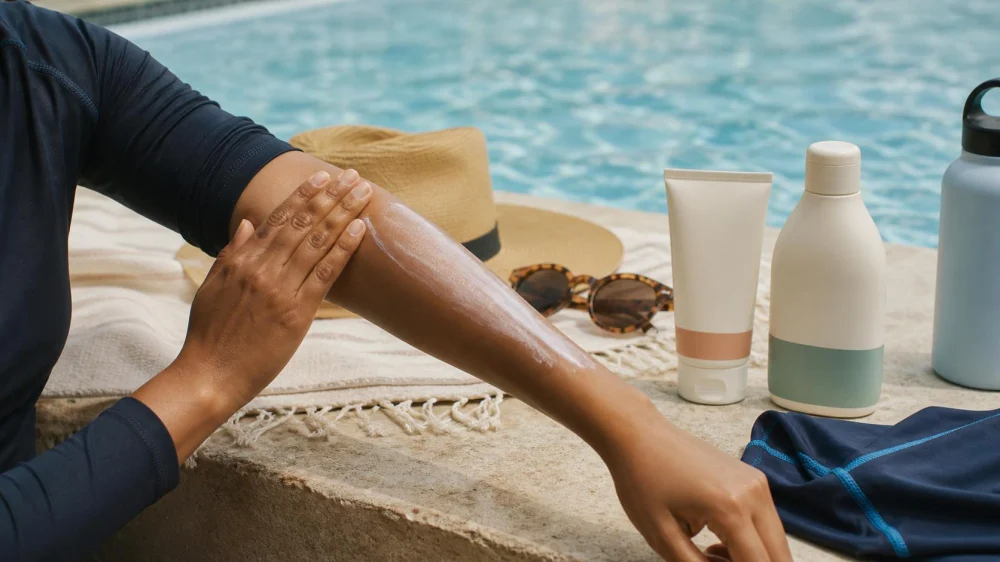
Use enough product to cover all exposed skin and apply at the time specified on the label before going outdoors. Commonly missed areas include ears, hairline, scalp with thin hair, neck, tops of feet, backs of hands, swimsuit edges, and the back of the legs.
For lotion, work section by section so coverage is even. For a stick, use repeated passes as the label directs and blend when appropriate. For sprays, follow distance and rubbing directions, avoid inhalation, never spray directly onto the face, and keep away from flame or heat when the label warns of flammability.
Let sunscreen form an even film before dressing or entering water according to the product directions. Clothing friction can remove product, so check straps, waistbands, and life-jacket edges.
Reapply by events, not memory
Set a timer, but also use event-based triggers:
- after 40 or 80 minutes of swimming or sweating, according to the label;
- immediately after towel drying;
- after clothing or equipment rubs product away;
- at least every two hours while outdoors, unless the label directs more frequent application; and
- after washing exposed skin.
Leaving the water does not reset protection. Time spent swimming or sweating accumulates, and a fresh application should follow the label rather than guesswork.
Combine sunscreen with other protection
No sunscreen blocks all UV radiation. Reduce exposure with shade, tightly woven or UV-protective clothing, a broad-brimmed hat, sunglasses, and activity timing. UV reaches skin on cloudy days and can reflect from water, sand, snow, and pavement.
Plan shade and breaks before arriving. Keep sunscreen accessible rather than locked in a distant car, but protect it from excessive heat. Bring enough for every person and every reapplication.
Adapt for sensitive skin and children
For children younger than 6 months, FDA advises keeping them out of the sun and using protective clothing; ask a pediatrician about sunscreen if shade and clothing are insufficient. Closely supervise application to prevent ingestion and eye contact.
For eczema, allergy, acne, or prior irritation, choose a suitable fragrance-free product and test a small area according to clinician advice. Stop and seek care for swelling, blistering, breathing symptoms, or a severe widespread reaction.
Some medicines increase sun sensitivity. Read medicine labels and ask a pharmacist or prescriber whether added protection or exposure limits are needed.
Limitations and important notes
Sunscreen does not make deliberate tanning safe and should not be used to extend exposure. SPF is not a clock. Product directions and U.S. labeling may differ from those in other countries.
Seek medical care for severe sunburn, extensive blistering, dehydration, confusion, fainting, or heat-illness symptoms. A changing, bleeding, or concerning skin spot needs clinical assessment rather than more sunscreen.
Sources and evidence notes
FDA explains broad-spectrum and SPF labeling, states that no sunscreen is waterproof, recognizes 40- or 80-minute water-resistance claims, and directs users to reapply after swimming, sweating, or towel drying according to the label.
Frequently asked questions
Does 80 minutes mean I can stay outside for 80 minutes?
No. It is a water-resistance claim, not a safe-exposure timer. Use other protection and follow all reapplication directions.
Do I reapply if I only towel dried?
Yes. FDA guidance notes that toweling can wipe sunscreen away.
Is higher SPF automatically water resistant?
No. SPF and water resistance are separate label claims. Check both.
Can sunscreen be called waterproof?
No sunscreen is waterproof under current U.S. labeling. Look for a 40- or 80-minute water-resistance statement.
Does sunscreen replace a rash guard?
No. Clothing, shade, hats, and sunglasses add protection and reduce dependence on perfect application.
Next steps
Read the label before the next swim, choose broad-spectrum protection with the needed water-resistance claim, apply every exposed area on time, and set both timer and event-based reapplication reminders. Pack shade and protective clothing too.



 Skin Cancer Centers of America5.0 (4 reviews)
 Skin Fitness,LLC0.0 (0 reviews)
 K BEAUTY & SKIN CARE5.0 (37 reviews)
 SKINREMEDY5.0 (53 reviews)
 Bloomstore LLC0.0 (0 reviews)
 Skin Laundry - Denver Highlands4.0 (238 reviews)
 How to Use Papaya Extract for Smoother, Brighter Skin
 Best Skin Care Routine For Inflamed Skin In People Over 40 | SkinCare Experts
 How To Prevent Hyaluronic Acid From Causing Whiteheads
 How to Avoid Skin Damage from Extreme Weather Conditions: Expert Tips for Healthy Skin
 What Is the Best Skin Care Routine for Sensitive Skin?
 The Best Natural Oils for Skin Care and Their Benefits