
Lotion, Cream, or Ointment? Compare Moisturizer Textures
On this page
Quick answer
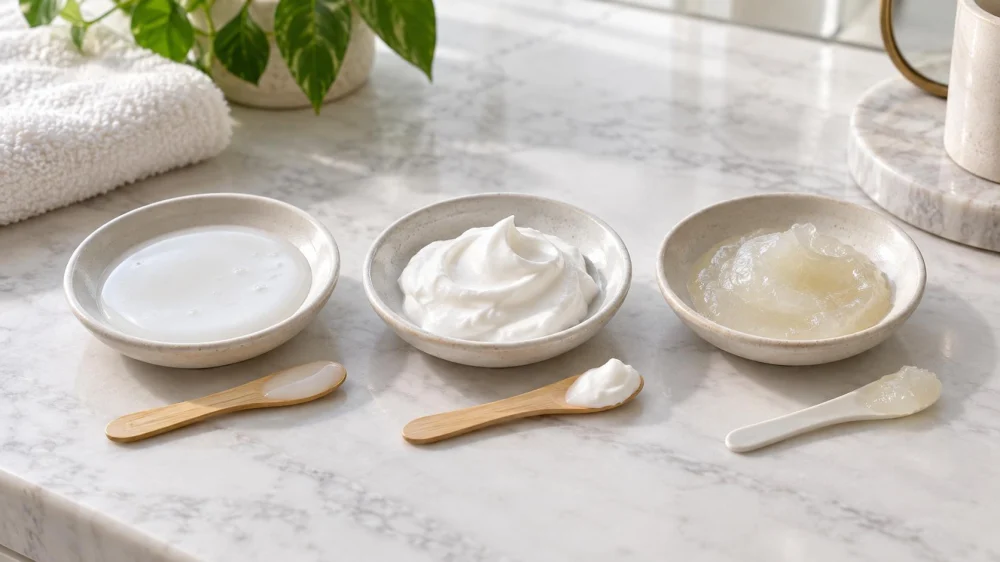
Lotions are usually lighter and easier to spread over large or hairy areas. Creams are thicker and often balance moisture retention with comfortable daily wear. Ointments are greasier and more occlusive, making them useful for very dry, cracked, or friction-prone spots when appropriate. The best choice depends on ingredients, skin condition, body area, climate, preference, and a clinician’s plan—not the texture name alone.
A moisturizer supports the skin barrier by adding water, attracting water, smoothing gaps between surface cells, or reducing water loss. Many formulas combine these actions. “Lotion,” “cream,” and “ointment” describe broad physical forms, but products within a category can behave differently.
How the textures differ
Lotions contain more fluid and spread quickly. They can feel less heavy and may be convenient for arms, legs, scalp-adjacent skin, or daytime use. The lighter feel may require more frequent application for very dry skin.
Creams are semi-solid emulsions that often feel richer than lotions without the full greasiness of an ointment. They are widely used on face, hands, and body, but ingredients and finish vary greatly.
Ointments generally contain a high proportion of oily or occlusive material. They form a strong barrier against water loss and friction but can feel sticky, stain fabric, trap heat, or worsen follicle-related problems for some people.
Gels, balms, oils, butters, and barrier pastes add more options. The marketing name does not reliably predict the ingredient list or clinical effect.
Choose by skin, body area, and situation
- Large or hairy areas: a lotion or lighter cream may spread with less pulling.
- Hands and frequently washed skin: a cream may fit daytime use, with a more occlusive product at night if tolerated.
- Very dry patches: a thicker cream or ointment may reduce water loss better.
- Face or acne-prone areas: choose a formula compatible with the person’s condition and treatment, not simply the lightest label.
- Skin folds or hot weather: heavy occlusion can trap moisture and heat, so clinical guidance may be needed when irritation or infection is possible.
- After a procedure or on broken skin: use only the product and timing recommended by the treating clinician.
Preference matters. A theoretically strong product that feels unacceptable may be used inconsistently. Test a small amount for feel and compatibility when appropriate.
Look beyond the texture label
Check the full ingredient list and warnings. Humectants attract water, emollients smooth the surface, and occlusives reduce water loss. Fragrance, botanical extracts, preservatives, solvents, and active ingredients can irritate or trigger allergy in some people.
“Natural,” “clean,” “dermatologist tested,” “hypoallergenic,” and “for sensitive skin” do not guarantee that a product will suit everyone. Avoid assuming two products are interchangeable because the front labels sound similar. For a known allergy, review exact ingredients with a healthcare professional.
A moisturizer containing an active treatment—such as an exfoliating acid, retinoid, or medication—is not a plain moisturizer. Follow its directions and avoid stacking actives without a plan.
Apply a moisturizer effectively
- Use clean hands and dispense without contaminating the container.
- Apply after gentle cleansing or bathing while skin is slightly damp, unless instructions say otherwise.
- Spread a thin even layer without aggressive rubbing.
- Add more only where dryness remains rather than coating every area heavily.
- Let it absorb before dressing or applying another product.
- Reapply based on washing, dryness, product instructions, and clinician advice.
For a jar, use clean dry fingers or a clean applicator. Stop sharing personal products when contamination or infection is a concern.
When a moisturizer is not enough
Stop a new product and seek advice for significant burning, swelling, hives, blistering, or a rapidly spreading reaction. Urgent help is needed for breathing difficulty or facial or throat swelling.
Persistent cracking, bleeding, pain, pus, warmth, spreading redness, severe itch, or a rash that does not improve may indicate dermatitis, allergy, infection, or another condition that needs diagnosis. More occlusion can worsen some problems.
This article cannot select a product for eczema, psoriasis, acne, rosacea, wounds, radiation treatment, or post-procedure skin. Use individualized medical guidance.
Sources and evidence notes
This guide reflects basic dermatologic formulation principles: lotions are generally lighter, creams intermediate, and ointments more occlusive; ingredients and adherence matter as much as category. It avoids claiming that one texture is universally superior.
Frequently asked questions
Is ointment always best for dry skin?
No. It can reduce water loss strongly but may be uncomfortable or unsuitable in some areas and conditions. Use the texture you can tolerate and that fits the diagnosis.
Can I use body lotion on my face?
Sometimes, but fragrance, richness, active ingredients, and skin condition matter. Test cautiously and follow professional advice for reactive or acne-prone skin.
Does a thicker cream contain more water?
Not necessarily. Thickness and water content are related to the whole formulation. Read ingredients and use performance rather than appearance alone.
Why does moisturizer sting?
Damaged skin, certain ingredients, pH, or allergy may contribute. Brief mild sensation and significant burning are not the same; stop and ask a clinician when symptoms are strong or persistent.
Can I put ointment over a cream?
That can increase occlusion, but it is not appropriate for every condition or body area. Follow a clinician’s layering plan when treating a skin problem.
Conclusion and next steps
Compare moisturizer textures by spread, occlusion, body area, climate, ingredients, and whether you will use the product consistently. Start with a plain compatible formula, apply gently after washing, and adjust by response. Seek evaluation when dryness comes with pain, infection signs, severe reaction, or a persistent rash.


 Glow Ahead Skin Lab4.0 (12 reviews)
 Let's Face It Skin Care5.0 (177 reviews)
 Skinterest Regenerative Esthetics4.0 (26 reviews)
 Alliance Dermatology Associates4.0 (47 reviews)
 Mayday Skincare5.0 (1 reviews)
 Beverlee Botanicals -a Holistic Skin Studio5.0 (23 reviews)
 How To Repair Sun Damage Effectively With Proven Skincare and Professional Treatments
 How to Choose the Right Moisturizer for Combination and Oily Skin
 The Best Skin Care Routine for Youthful and Radiant Skin
 Dry Hands From Frequent Washing: Build a Gentler Routine
 How to Treat and Prevent Sun Damage with Natural Skin Care Solutions
 How To Balance Sun Damage In People Over 40