
How to Read a Sunscreen Label and Apply It Correctly
On this page
- Quick answer
- Decode the main label terms
- Choose for the situation
- Read the Drug Facts panel
- Apply sunscreen correctly
- Know when to reapply
- Use sprays, sticks, and tinted products safely
- Build a complete sun-protection plan
- Limitations and important notes
- Frequently asked questions
- Sources and evidence notes
- Next steps
Quick answer
Choose a U.S. sunscreen labeled Broad Spectrum, SPF 30 or higher, and water resistant when swimming or sweating. Apply a generous, even layer to all exposed skin before going outdoors, including ears, neck, feet, scalp gaps, and lips with an appropriate SPF lip product. Reapply at least every two hours and immediately after swimming or sweating according to the label's 40- or 80-minute water-resistance directions.
Decode the main label terms
Sunscreen is a topical product designed to reduce ultraviolet radiation reaching the skin when used as labeled. Its front label summarizes tested performance, but each term answers a different question.
- SPF: Primarily indicates protection against UVB, the radiation strongly associated with sunburn. A larger number does not make the product last longer.
- Broad Spectrum: Indicates the product passed the U.S. test for UVA protection relative to its UVB protection. UVA contributes to skin aging and skin-cancer risk.
- Water Resistant (40 minutes) or (80 minutes): States how long the tested protection is maintained during swimming or sweating under specified conditions. It does not mean waterproof.
- Active ingredients: The UV-filter ingredients and their concentrations appear in Drug Facts. “Mineral,” “chemical,” or “hybrid” marketing is less important than selecting a product you can apply correctly and consistently.
Choose for the situation
- Everyday exposed skin: Broad Spectrum SPF 30 or higher in a texture you will use generously.
- Swimming, sports, or heavy sweating: A water-resistant formula; compare the 40- and 80-minute statement and follow the exact reapplication directions.
- Sensitive or stinging skin: Consider a fragrance-free product and test a small area. A dermatologist may suggest a formula with zinc oxide and titanium dioxide.
- Acne-prone skin: Look for a compatible non-comedogenic texture, but remember the term does not guarantee that no individual will break out.
- Dark spots or visible-light concerns: A tinted product containing iron oxide may be useful as part of professional advice.
- Children: Follow age directions. For infants younger than 6 months, prioritize shade and protective clothing and ask a clinician about sunscreen use.
Read the Drug Facts panel
- Confirm the active ingredients and intended sunscreen use.
- Read warnings for broken skin, eye contact, irritation, and children.
- Follow directions for timing, application, water exposure, and reapplication.
- Check the expiration date and storage instructions. Do not rely on a product whose appearance, smell, or consistency has changed.
- Review inactive ingredients when you have known allergies or sensitivities.
- Do not assume makeup or moisturizer provides enough protection unless it carries the needed sunscreen labeling and is applied in the directed amount.
Apply sunscreen correctly
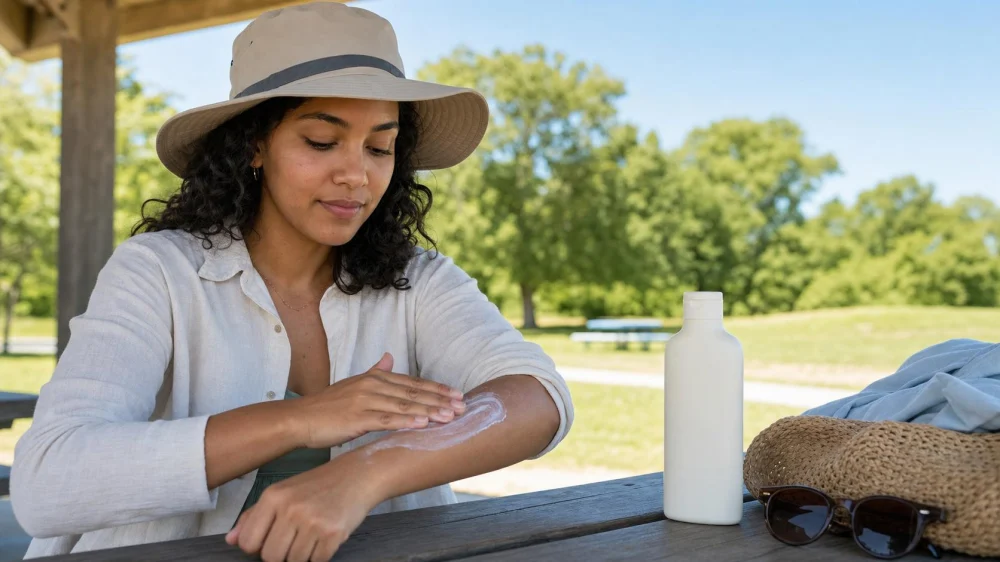
- Apply before outdoor exposure, following the product directions; dermatologists commonly advise about 15 minutes beforehand.
- Use enough to make a uniform film. The American Academy of Dermatology notes that most adults need about one ounce for exposed body skin, adjusted for body size and coverage.
- Cover commonly missed areas: ears, hairline, neck, chest, backs of hands, tops of feet, lower legs, and edges around clothing.
- For thinning hair, apply an appropriate product to exposed scalp or use a broad-brimmed hat.
- Use SPF lip balm on exposed lips and reapply it as directed.
- Let the layer settle before dressing or entering water, according to the label.
Know when to reapply
Reapply at least every two hours while outdoors, and sooner after swimming, sweating, or towel drying. For a water-resistant product, the 40- or 80-minute statement helps define the maximum tested interval in water or sweat; follow the label rather than waiting for two hours.
Reapply after clothing friction, wiping the face, or another activity that removes the film. High SPF does not cancel reapplication, and applying two different low-SPF products does not reliably add their numbers together.
Use sprays, sticks, and tinted products safely
- Spray: Apply enough for even coverage and rub in when directed. Do not inhale it, spray near the face or mouth, or use near flame or while smoking.
- Stick: Make multiple passes over each area, cover edges and curves, then smooth gaps as directed.
- Tinted: Blend an even layer; selecting a wearable shade can improve consistent use, but undertone does not replace tested SPF and broad-spectrum labeling.
- Powder: Follow its Drug Facts directions. Do not assume a light cosmetic dusting provides the same coverage as a correctly applied primary sunscreen.
Build a complete sun-protection plan
No sunscreen blocks all ultraviolet radiation. Pair it with shade, a wide-brimmed hat, UV-protective sunglasses, and clothing that covers the skin. Plan outdoor activities to reduce intense exposure when practical, and remember that clouds, reflection, altitude, and seasonal conditions can affect exposure.
Sun protection is relevant across skin tones. Darker skin can burn and develop UV-related damage, and sunscreen selection should also consider visible residue, sensitivity, and conditions such as hyperpigmentation.
Limitations and important notes
This guide covers over-the-counter sunscreen use in the United States. Labels and approved ingredients differ among countries. A clinician's advice may differ for infants, pregnancy, allergies, photosensitizing medicines, lupus, pigment disorders, prior skin cancer, or active skin disease.
Stop using a product and seek medical advice for a serious reaction. A severe sunburn with extensive blistering, fever, confusion, dehydration, or illness may require prompt care. New, changing, bleeding, or nonhealing skin lesions should be evaluated rather than covered with cosmetic products.
Frequently asked questions
Does SPF 50 last longer than SPF 30?
No. SPF is not a time rating. Both require correct application and reapplication based on time, water, sweat, wiping, and label directions.
What does Broad Spectrum mean?
It means the sunscreen passed the applicable test for UVA protection in relation to UVB protection. SPF alone mainly describes UVB performance.
Is water-resistant sunscreen waterproof?
No. U.S. labels specify 40 or 80 minutes of tested water resistance. Reapply according to that statement and after towel drying.
Can I mix sunscreen with moisturizer?
Mixing may dilute or disrupt the tested film. Apply products in separate layers according to their labels, allowing each to settle as needed.
Can I use last year's sunscreen?
Check the expiration date, storage history, and product condition. Replace expired sunscreen or any product exposed to excessive heat or showing changes in color, smell, separation, or texture.
Sources and evidence notes
The FDA sunscreen labeling guide explains SPF, Broad Spectrum, water-resistance statements, and reapplication directions. The American Academy of Dermatology's sunscreen application guidance recommends broad-spectrum, water-resistant SPF 30 or higher, sufficient coverage, application before exposure, and regular reapplication.
Next steps
Check your current bottle for Broad Spectrum, SPF, water-resistance time, expiration, and Drug Facts directions. Keep a usable amount where you prepare to leave, add a travel-size option when appropriate, and set a practical reapplication reminder for long outdoor days.



 Joanna Moreno Skincare0.0 (0 reviews)
 LUX WELLNESS & SKIN THERAPY - Salmon Creek, Vancouver4.0 (135 reviews)
 Eastside Esthetics5.0 (2 reviews)
 Brilliance Dermatology - Calabasas4.0 (360 reviews)
 Sarah's European Skin Care4.0 (9 reviews)
 Infinity Rejuvenation Bar0.0 (0 reviews)
 How to Improve Skin Elasticity with the Right Skincare Routine
 How To Soothe Redness For People Living In Humid Climates
 How to Manage Blackheads: Expert Tips for Clearer Skin
 Natural Remedies for Eczema in Athletes | SkinCare Experts
 How to Treat and Prevent Skin Discoloration from Acne Scarring
 The Truth About Skin Care Myths: What’s Real and What’s Fake?