
How to Avoid Mixing Up Skincare Products in a Shared Home
On this page
- Quick answer
- Why product mix-ups matter
- Assign each person a clear zone
- Identify products without altering labels
- Use shared-space hygiene rules
- Separate prescriptions and higher-risk items
- Shared-bathroom reset checklist
- Limitations and important notes
- Frequently asked questions
- Sources and evidence notes
- Create visible ownership today
Quick answer
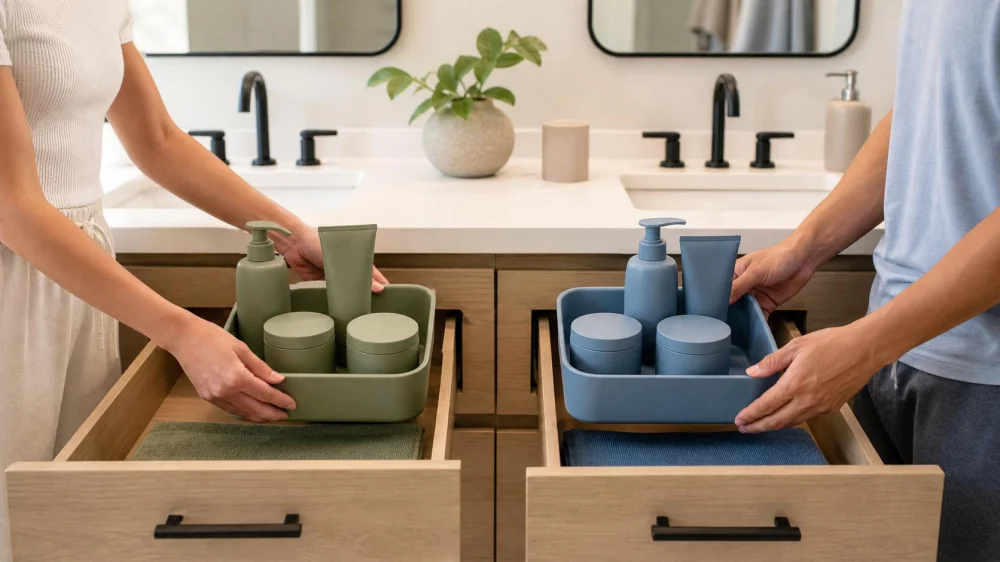
Prevent skincare mix-ups by giving each person a separate bin or shelf, keeping products in original labeled containers, and marking ownership on the bin rather than covering product directions. Do not share prescriptions, applicators, jar products, or anything used on irritated or infected skin. Store look-alike bottles apart, use clean dry hands, and tell others immediately if the wrong product was used.
This guide is for U.S. households sharing a bathroom, vanity, or travel space. It covers organization and hygiene, not diagnosis or product suitability. Follow product labels and instructions from a dermatologist, pharmacist, or other qualified clinician.
Why product mix-ups matter
Two containers can look nearly identical while containing different strengths, active ingredients, fragrances, or intended uses. One person may tolerate a product that irritates another. A prescription or medicated item is intended for a specific patient and plan.
Mix-ups also happen when containers move after cleaning, visitors unpack similar products, labels face the wall, or someone decants a product into an unmarked bottle. Sharing applicators or repeatedly dipping fingers into the same jar can transfer oils, debris, or microorganisms.
The goal is not to make a shared bathroom sterile. It is to make ownership obvious and prevent avoidable cross-use.
Assign each person a clear zone
Give each household member a defined location: a shelf section, drawer divider, handled bin, or toiletry case. Use enough space that products remain upright and labels are visible.
Choose zones by access and safety. Keep adult products, medications, sharp tools, and breakable containers away from children and pets. A higher shelf is not sufficient when a child can climb; use secure storage appropriate to the household.
Separate everyday items from occasional treatments. This reduces the chance that a strong or unfamiliar product is grabbed during a rushed routine. Keep shared non-skincare supplies in their own area so “community shelf” does not imply every product is shared.
Identify products without altering labels
Keep each item in its original container with the product name, ingredient information, directions, warnings, lot information, and expiration details readable. Do not cover important text with ownership tape.
Identify ownership by:
- using different colored bins or washable bin tags;
- placing a name on the shelf edge or toiletry case;
- adding a small removable mark to the container base when it does not cover information;
- storing look-alike bottles in different zones; and
- keeping a routine card inside each person's bin rather than writing on product directions.
Avoid transferring products into decorative containers. If a product must be dispensed for travel under applicable rules, use a suitable clean container and identify the contents and owner accurately. Keep the original packaging available for directions.
Use shared-space hygiene rules
Wash and dry hands before applying products. Close caps promptly and keep pumps and openings from touching skin. Follow the manufacturer's instructions for cleaning any included applicator.
Products in open jars are harder to keep individual when several people dip into them. Assign the jar to one user, or choose a pump format when appropriate. Do not add water to thin a product or return excess product to the container.
Keep towels, washcloths, reusable pads, facial devices, razors, and makeup applicators assigned to one person unless the item is specifically designed and safely cleaned for shared use. Launder or clean them according to material and product guidance, and let them dry fully.
Wipe shelves after leaks. Do not let a spilled product coat another container's opening or label. Discard an item according to guidance if its contents may be contaminated or cannot be identified confidently.
Separate prescriptions and higher-risk items
Store prescription skincare with the patient's other medicines or in another secure, clearly assigned location as directed. Never share it, even when two people believe their symptoms look the same.
Give extra separation to products with strong active ingredients, known household allergies, small child-resistant packages, or directions that limit application area or frequency. Child-resistant packaging is not childproof.
If someone uses the wrong product, rinse or follow the label's immediate instructions as applicable, stop further use, and identify exactly what was applied, where, how much, and when. Contact a pharmacist, clinician, poison resource, or emergency service according to the product and symptoms. Severe swelling, trouble breathing, faintness, eye injury, or rapidly worsening symptoms require urgent help.
Shared-bathroom reset checklist
- Remove empty, unidentified, leaking, and obviously unusable containers.
- Return every item to its original owner and readable packaging.
- Assign a separate bin, drawer, or shelf zone to each person.
- Move prescriptions and higher-risk items to secure individual storage.
- Separate look-alike bottles and personal applicators.
- Check that product directions and dates remain visible.
- Clean spills and dry the storage area.
- Explain the household rule: ask before using any item outside your zone.
Limitations and important notes
- Bathroom heat, humidity, and sunlight may not suit every product; follow label storage directions.
- Do not combine products in one bottle or move prescription labels to another container.
- Household organization cannot determine whether a product is safe for a particular person or condition.
- Visitors should receive their own temporary storage area rather than adding items to another person's bin.
- Local disposal options vary for medicines, aerosols, and packaging; use current community and product guidance.
Frequently asked questions
Is it safe for family members to share moisturizer?
Suitability and contamination risk depend on the formula, packaging, skin condition, and users. Individual pump products reduce mix-ups, but each person should use products appropriate for them and follow the label.
Can I label a skincare bottle with tape?
A small removable ownership mark may help if it does not cover directions, warnings, ingredients, lot details, or dates. Labeling the bin is often clearer.
What should I do with an unmarked travel jar?
If you cannot identify its contents confidently, do not apply it. Guessing by color, smell, or texture is unreliable.
Should skincare be stored outside the bathroom?
Follow each product's stated storage conditions. Some households use a dry cabinet or bedroom organizer when bathroom heat and humidity are unsuitable.
Can two people use the same facial tool?
Check the device instructions. Many personal-contact tools should not be shared, and cleaning may not make every design suitable for multiple users.
Sources and evidence notes
The organization method reflects common product-safety and hygiene principles: preserve original labels, separate medicines by patient, reduce direct container contact, prevent cross-use, follow storage directions, and obtain prompt guidance after significant accidental exposure. Manufacturers, pharmacists, and qualified clinicians provide product- and person-specific advice.
Create visible ownership today
Empty one shared shelf and sort every item by owner. Give each person a labeled bin, move prescriptions to secure individual storage, and separate look-alike containers. End with one household rule everyone can follow: if a product is not in your zone, ask before touching it.



 Acne Specialists of Walnut Creek5.0 (26 reviews)
 Complete Care Dermatology4.0 (99 reviews)
 Amazing Skin Aesthetics4.0 (61 reviews)
 Noelle Ashland Wellness5.0 (1 reviews)
 Mackenzie Rose Esthetics LLC5.0 (17 reviews)
 Dermatology San Antonio4.0 (2476 reviews)
 How to Deal with Uneven Skin Tone Using Natural Remedies
 How To Get Rid Of Age Spots In People With Sensitive Skin | SkinCare Experts
 How to Treat Acne and Manage It: Effective Tips for Clear Skin
 Natural Remedies For Scars: What You Need To Know
 How to Achieve Perfect Skin with a Multi-Step Skincare Routine
 How to Use Coconut Oil for Healthy, Hydrated Skin