
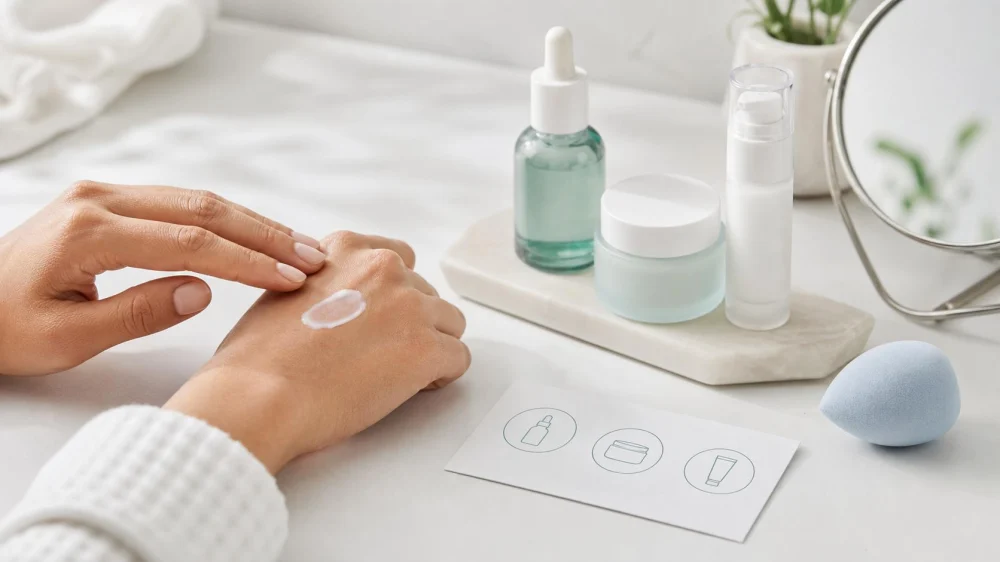
Why Skincare Products Pill and How to Adjust Your Routine
On this page
- Quick answer
- What skincare pilling is
- Common causes
- Find the layer causing the problem
- Adjust amount and order
- Change application technique
- Protect sunscreen and makeup performance
- When to simplify or switch products
- A one-week troubleshooting plan
- Limits and skin-safety notes
- Sources and evidence notes
- Frequently asked questions
- Conclusion and next steps
Quick answer
Skincare pilling happens when product forms small flakes or rolls on the skin instead of settling into an even film. Common causes include too much product, too many layers, rubbing, insufficient drying time, or incompatible film-forming textures. Troubleshoot by simplifying, using thinner amounts, letting each layer set, pressing instead of rubbing, and testing one product combination at a time.
What skincare pilling is
Pilling is the formation of visible rolls, crumbs, or flakes when skincare or makeup layers move across one another. The material can be dried product, a blend of product and skin flakes, or a film that breaks apart under friction.
Pilling is usually a cosmetic application problem, not proof that ingredients are unsafe or that nothing absorbed. It also does not show that two ingredients chemically “cancelled” each other.
This guide is for U.S. consumers troubleshooting routine texture. It does not diagnose a skin condition. New redness, swelling, burning, hives, blistering, or persistent scaling requires a different response than ordinary pilling.
Common causes
- Excess amount: thick layers take longer to set and leave more material to roll.
- Too many films: several serums, gels, moisturizers, primers, sunscreens, and foundations can create competing layers.
- Friction: repeated massaging, rubbing makeup, or touching the face lifts partially set film.
- Short wait time: a watery layer can dilute the next product, while a tacky layer can grab and bunch it.
- Texture mismatch: some high-silicone, polymer-rich, powdery, or gel formulas do not layer smoothly together.
- Surface dryness: loose skin flakes can mix with product and look like pilling.
- Old or changed product: heat, age, freezing, or contamination can alter texture.
Ingredient lists alone rarely predict every combination because concentration and formulation matter. The most useful evidence is a controlled test on your own skin.
Find the layer causing the problem
Begin with a clean routine rather than adding more product. On one morning, apply only moisturizer and sunscreen. If that works, add one usual serum on another day. Test makeup separately after the skincare base succeeds.
Observe when the pills appear:
- During the first product: check product age, amount, skin flakes, and rubbing.
- After moisturizer: test serum plus moisturizer and moisturizer alone.
- After sunscreen: test sunscreen on clean dry skin and over moisturizer.
- During makeup: test the foundation over sunscreen without primer, then add primer separately.
Use the same cleanser, quantities, and waiting times during each comparison. Changing several variables at once hides the cause.
Adjust amount and order
Follow each label for quantity and use. For non-sunscreen layers, start with the smallest amount that covers the intended area and add only if needed. A dropper does not mean the full dropper is one dose.
Apply lighter, water-based textures before heavier creams when product instructions allow. Oil is not always last, and silicone is not always incompatible with water-based formulas; finished products are more complex than a single ingredient rule.
Do not reduce sunscreen below the labeled amount simply to prevent pilling. Instead, simplify products underneath, let them set, and choose a sunscreen texture that forms an even film in the required quantity.
Change application technique
Apply products to skin that is in the condition the label specifies—dry, damp, or otherwise. Spread each layer evenly with a few gentle strokes, then stop touching it.
Allow the surface to set before the next layer. There is no universal wait time; texture, humidity, amount, and formula matter. The surface should not be wet or moving when you lightly touch an edge.
For later layers, press or pat rather than repeatedly rubbing. Use clean hands and tools. With foundation, try a damp sponge or gentle stippling motion instead of dragging a brush across sunscreen.
Avoid rolling motions when applying around facial hair, brows, and dry patches, where products tend to collect.
Protect sunscreen and makeup performance
Sunscreen must form a complete, even film. If it pills, patchiness may reduce reliable coverage even when you applied the intended amount. Do not brush away pills and assume protection remains uniform.
Apply sunscreen as the label directs and let it set before makeup. When it still pills over all moisturizers, test it on clean skin or choose a compatible moisturizer. When it pills on its own at the labeled amount, consider a different sunscreen.
Makeup primers are optional. A primer that improves one foundation can disrupt another sunscreen. Test the fewest layers that deliver the finish and protection you need.
Reapplication also can pill. Press sunscreen over makeup with a method that maintains the labeled amount and even coverage, or use a routine you can realistically reapply. Powder or spray products should be used only according to their instructions and should not be assumed equivalent to a full initial application.
When to simplify or switch products
Simplify when you use multiple products with overlapping goals or several thick, tacky, or film-forming textures. A basic cleanser, moisturizer when needed, and sunscreen can be a useful baseline.
Switch one product when:
- It pills alone at the labeled amount.
- It has changed smell, color, or texture or passed its use period.
- It cannot layer with an essential product such as sunscreen.
- It repeatedly irritates your skin.
- The routine requires amounts or waiting times you will not maintain.
Do not keep an irritating product because it was expensive. Stop use and seek professional guidance for a significant reaction.
A one-week troubleshooting plan
- Day 1: Check expiration, storage, and visible texture changes.
- Day 2: Test moisturizer alone on clean skin.
- Day 3: Test sunscreen alone at the labeled amount.
- Day 4: Test moisturizer, wait until set, then sunscreen.
- Day 5: Add one serum in a thin layer.
- Day 6: Add makeup without primer.
- Day 7: Test primer only if it solves a defined need.
Record amounts, wait times, application motion, and where pilling begins. Stop any day irritation appears.
Limits and skin-safety notes
Pilling should not be confused with peeling skin. Persistent flaking can come from dryness, irritation, dermatitis, sunburn, acne treatments, or another condition. A dermatologist can evaluate ongoing symptoms.
Do not exfoliate aggressively to solve rolling product. Scrubs, acids, retinoids, and other active products can worsen irritation when the skin barrier is already stressed.
Seek prompt medical help for swelling of the face or throat, breathing difficulty, widespread hives, blistering, or a severe reaction. Stop suspected products and bring labels or ingredient lists to the clinician.
Sources and evidence notes
This article reflects common cosmetic-formulation and dermatology practice: control variables, use labeled amounts, minimize friction, allow films to set, protect sunscreen coverage, and distinguish product pilling from skin disease.
Formulas vary beyond simple ingredient categories. Use product labels, current U.S. sunscreen directions, and a board-certified dermatologist for persistent irritation or a medical concern.
Frequently asked questions
Does pilling mean my products are incompatible?
Possibly, but amount, friction, wait time, and dry skin can produce the same result. Test fewer layers first.
Should I wait a fixed number of minutes?
No universal time works for every formula. Wait until the prior layer is no longer wet or moving.
Can I use less sunscreen to stop pilling?
Do not under-apply. Simplify underneath or choose a formula you can use evenly at the labeled amount.
Why does makeup pill when skincare does not?
The makeup, primer, tool, or rubbing motion may disrupt the set sunscreen or moisturizer. Test makeup without primer and stipple gently.
Is pilling the same as peeling?
No. Pilling is product rolling; peeling is skin shedding. Persistent or irritated peeling needs a skin-focused evaluation.
Conclusion and next steps
Tomorrow, test only moisturizer and sunscreen using labeled amounts and gentle application. If the film stays smooth, add one layer per day until pilling returns. Reduce unnecessary layers, allow each to set, and press rather than rub. Keep sunscreen amount intact. If the skin itself is peeling or irritated, stop troubleshooting product texture and seek appropriate skin care advice.



 Skin Fairy Aesthetics5.0 (93 reviews)
 Beauon K | 파메스테틱 | 플러싱스킨케어 | 뉴욕스킨케어 | 플러싱 반영구, 두피관리 SMP5.0 (33 reviews)
 Friday Harbor Salon4.0 (11 reviews)
 Brow Lounge4.0 (45 reviews)
 DYLightful Skincare5.0 (11 reviews)
 Forever Medspa & Wellness Center4.0 (158 reviews)
 Benefits of Using Rosacea With a Simple Routine: A Guide for Clearer Skin
 Top Tips for Fine Lines in Women: How to Manage and Reduce Them
 Daily Skin Care Routine For Dry Skin With A Simple Routine
 How to Achieve Flawless Skin Without Expensive Treatments
 Essential Tips for Taking Care of Your Skin After a Facial Treatment
 How to Avoid Scars: Essential Tips for Skin Care