
Travel Skin Care Containers: Fill, Label, and Pack Safely
On this page
- Quick answer
- Decide what should not be decanted
- Choose a compatible container
- Clean and fill without contamination
- Preserve essential label information
- Prevent leaks and exposure
- Use products hygienically during travel
- Handle leftovers after the trip
- Sources and evidence notes
- Frequently asked questions
- Conclusion and next steps
Quick answer
Decant only products that remain stable and identifiable in a clean, compatible travel container. Keep sunscreen, prescriptions, products with required dosing, and light- or air-sensitive formulas in original packaging unless the manufacturer or pharmacist confirms another container. Clean and dry tools, label every decanted product with identity and date, pack it upright in a leak-resistant pouch, and discard anything that changes.
Decide what should not be decanted
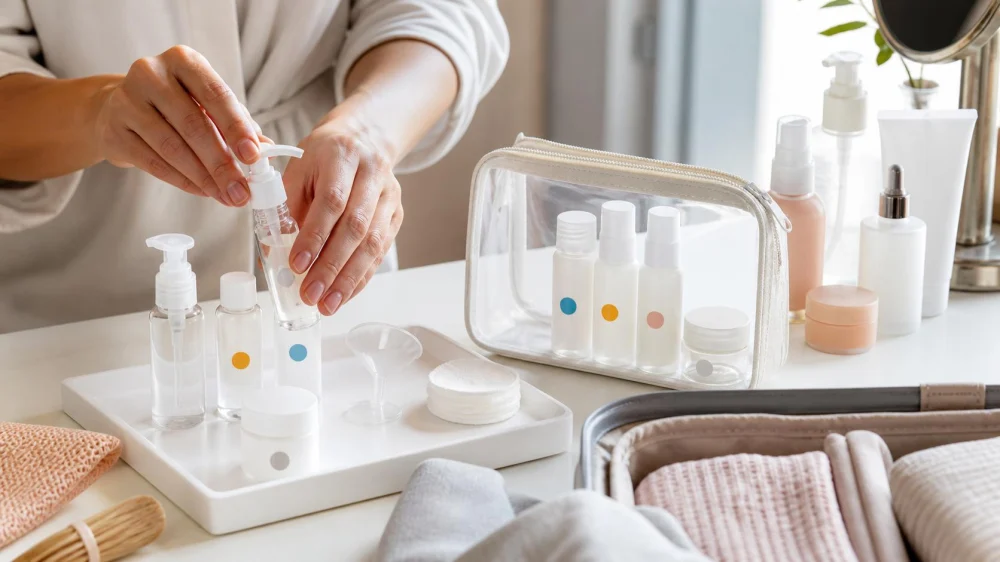
Decanting means transferring a product from its original package into a smaller container. It saves space, but it can remove the label, lot number, expiration, directions, ingredient list, warning, dose control, and packaging protection.
Keep a product in its original container when:
- it is a prescription or medicated product with dosing and pharmacy information;
- the package protects it from light, air, moisture, or contamination;
- the pump, dropper, airless system, or measured opening controls delivery;
- it is sunscreen whose performance depends on a compatible, protective package;
- the formula is unstable or the manufacturer advises against transfer;
- you need the original ingredient and warning label for an allergy or border inspection;
- the trip container cannot be identified reliably.
Travel-size original products or samples from a reliable source can be safer than decanting. Do not reuse an unlabeled sample sachet or refill a disposable package not designed for repeated use.
Choose a compatible container
Match the container to the texture and protection needs. A pump can reduce finger contact for lotion. A squeeze bottle may suit cleanser. A small jar exposes the contents to fingers and air each time it opens.
Check that the container is:
- made for cosmetic or personal-care use;
- compatible with oils, alcohols, acids, or other relevant ingredients;
- opaque or tinted when the product requires light protection;
- small enough for the planned number of uses;
- easy to clean and dry completely;
- securely closed without cracks, warped threads, or a loose pump;
- different enough from food, medicine, and household chemical containers to avoid confusion.
Do not use food jars for skin care or cosmetic jars for food. Avoid glass when breakage is a concern, and never put a skin product into an eye-drop or oral-medicine container.
Clean and fill without contamination
- Wash your hands and clean the work surface.
- Disassemble reusable containers only as their instructions permit.
- Wash and disinfect by the method recommended for the container and product.
- Rinse when required and allow every part to dry completely.
- Inspect for odor, residue, cracks, cloudiness, or damaged seals.
- Transfer product without touching the opening, pump stem, or interior.
- Use a clean dedicated spatula or funnel when needed.
- Leave headspace and close immediately.
- Wipe the outside and perform a leak test over a washable tray.
Do not “top off” old product with new product. Empty, clean, dry, and inspect the container first. Mixing batches can spread contamination and makes age difficult to track.
Fill only what you expect to use, plus a modest amount for delay. A nearly full original bottle transferred into several containers increases opportunities for contamination and mislabeling.
Preserve essential label information
At minimum, label the travel container with the exact product name or a unique code, purpose, fill date, and morning or evening use. Add the expiration or discard date when applicable.
Keep a photo of the original front and back label showing:
- ingredients;
- directions and frequency;
- warnings and storage conditions;
- lot or batch number;
- expiration or period-after-opening symbol;
- manufacturer contact information.
A colored dot alone is not enough unless a separate legend travels with it. Do not identify two clear liquids only by memory. If another person might handle the pouch, use plain names and keep it away from children and pets.
Prevent leaks and exposure
Close every cap, lock pumps when designed to lock, and place containers upright in a washable leak-resistant pouch. Separate liquids from electronics, clothing, medication, contact lenses, and documents.
Pressure and temperature can change during a flight or car trip. Do not overfill. Put very liquid products in individual secondary bags. Check current transportation-security rules for carry-on volume, screening, medication, and international entry.
Avoid leaving skin care in a hot vehicle, direct sun, freezing luggage compartment, or humid shower area. Use the storage range on the original label. A cooler is not automatically appropriate because condensation and freezing can also damage formulas.
Use products hygienically during travel
Wash and dry hands before use. Dispense without touching the opening to skin. Use a clean spatula for jars and keep it in a clean case rather than inside the product unless designed for that purpose.
Do not share eye-area, lip, jar, or applicator products. Keep caps off counters and close products promptly. If a container falls open, becomes flooded, develops odor, separates unexpectedly, changes color or texture, or causes a new reaction, stop using it.
Travel is not the ideal time to introduce several new active products. Climate, water, stress, sleep, and sun exposure already change the skin environment. Keep the routine simple and seek medical care for severe swelling, blistering, breathing difficulty, eye involvement, or a rapidly worsening reaction.
Handle leftovers after the trip
Do not pour leftover product back into the original package. The travel container may have introduced air, moisture, heat, or microbes.
If the product remained stable, cleanly handled, correctly stored, and clearly dated, continue using it within the appropriate period. Otherwise discard it according to product guidance.
Empty reusable containers, wash and dry them completely, inspect seals, and store them open or disassembled as recommended. Keep the labels with the containers or remove them fully so a future fill is not misidentified.
Sources and evidence notes
This routine follows broad cosmetic hygiene and packaging principles: preserve required information, minimize contact, avoid mixing batches, protect formulas from incompatible light and temperature, and discard products that change.
The product manufacturer is the primary source for packaging compatibility, stability, storage, and expiration. Pharmacists and prescribing clinicians provide medication handling instructions. Transportation authorities publish current travel rules.
Frequently asked questions
Can I transfer sunscreen into a travel bottle?
Keep it in original or manufacturer-approved packaging unless the manufacturer confirms compatibility. Transfer can remove protection and required labeling.
Can I reuse hotel toiletry bottles?
Only if they are designed for reuse and can be fully cleaned, dried, inspected, and correctly labeled. A purpose-built container is easier to manage.
How much product should I pack?
Estimate uses per day, trip days, and a small delay margin. Test the pump or amount at home rather than guessing by container size.
Can I mix two products to save space?
No unless the manufacturer explicitly directs it. Mixing can change stability, dose, texture, and irritation risk.
What if the product separates?
Follow its label. Unexpected separation, odor, color, texture, or container swelling is a reason to stop and verify before use.
Conclusion and next steps
Safe travel skin care depends on knowing when not to decant. Preserve original packaging for products that require it, and use clean compatible containers only for stable, clearly identified formulas.
Your next step is to reduce the routine to essentials, choose original travel sizes first, and label any necessary transfer with product and date. Leak-test the pouch, save label photos, protect it from heat and light, and never pour leftovers back.


 Perpetual Skin5.0 (30 reviews)
 Oasis Skin & Cosmetic Tattoos5.0 (15 reviews)
 SkinWorks5.0 (16 reviews)
 Eos Skin and Laser Clinic5.0 (16 reviews)
 Hope's Transformations5.0 (1 reviews)
 NAK Health & Beauty5.0 (12 reviews)
 The Best Skincare Products for Dealing with Acne and Oily Skin
 How to Choose the Right Puffy Eyes Solution for Teens
 Face Feels Tight After Cleansing: What to Change First
 Top Skincare Ingredients to Prevent Skin Inflammation Effectively
 Skin Care Tips for Treating Scars with Eye Creams
 Tips For Sensitive Skin With Fine Lines Effectively