
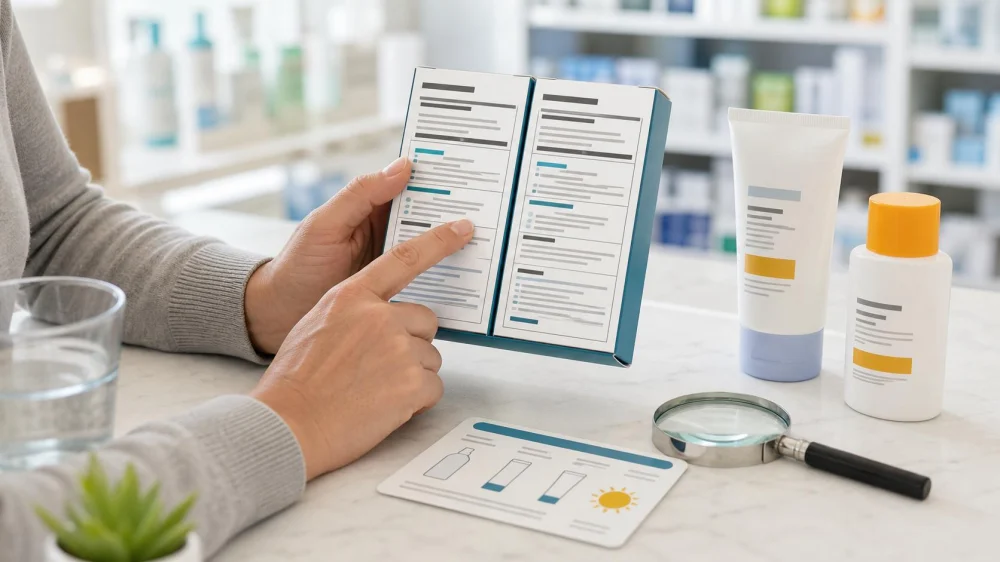
How to Read an OTC Acne Product Drug Facts Label
On this page
- Quick answer
- Why Drug Facts matters
- Active ingredient and purpose
- Match the uses to your acne
- Read every warning
- Follow directions, amount, and frequency
- Inactive ingredients and storage
- Fit one medicine into a simple routine
- Product comparison checklist
- When to seek professional care
- Sources and evidence notes
- Frequently asked questions
- Conclusion and next steps
Quick answer
Read an over-the-counter acne label in order: active ingredient and strength, purpose, uses, warnings, directions, inactive ingredients, and storage. Match the medicine to the blemish type and follow the exact frequency rather than combining several acne products at once. Re-read every package because similar product names can contain different medicines. Stop and seek help for a severe reaction.
Why Drug Facts matters
In the United States, nonprescription medicines use a standardized Drug Facts label. The U.S. Food and Drug Administration requires important information in a consistent order so consumers can compare and use over-the-counter, or OTC, products.
An acne cleanser, gel, cream, lotion, or pad can be a drug when it is marketed to treat acne. The marketing front may emphasize speed, texture, or skin type, but Drug Facts identifies the medicine, approved use, warnings, and directions.
This guide is for adults and caregivers learning to read a label. It does not determine whether a product is appropriate for an individual, a child, pregnancy, breastfeeding, another condition, or a prescription routine. Ask a pharmacist, physician, or board-certified dermatologist when uncertain.
Active ingredient and purpose
The active ingredient is the substance intended to produce the therapeutic effect. The label also shows its strength and purpose. Common OTC acne medicines can include benzoyl peroxide, salicylic acid, sulfur combinations, or adapalene products under their specific labeling.
Do not compare only brand names. Two packages with nearly identical design may use different active ingredients or strengths. A cleanser and a leave-on gel with the same active ingredient can also have different directions.
More strength is not automatically more effective for you. The American Academy of Dermatology advises that starting with a lower-strength benzoyl peroxide product can reduce dryness and irritation for many people. Use the labeled product or professional recommendation rather than escalating on your own.
Match the uses to your acne
The Uses section states what the product treats. Read it literally. An acne medicine is not automatically appropriate for rosacea, eczema, folliculitis, an allergic rash, or every bump around the mouth.
Acne can include blackheads, whiteheads, small pimples, and deeper nodules or cysts. The AAD notes that different active ingredients address different acne patterns; salicylic acid can help unclog pores, while adapalene and benzoyl peroxide have other roles in acne treatment.
If you are not sure the condition is acne, do not keep adding acne medicine. A dermatologist can diagnose look-alike conditions.
Read every warning
The Warnings section explains when not to use the medicine, conditions that require professional advice, areas to avoid, likely irritation, interactions with other topical medicines, when to stop, and when to get help.
Pay special attention to:
- External-use-only statements.
- Eyes, lips, mouth, broken skin, eczema, or sunburn restrictions.
- Age, pregnancy, and breastfeeding instructions.
- Sun exposure and sunscreen advice.
- Dryness, redness, burning, itching, peeling, or swelling.
- Using another topical acne medicine at the same time.
- Fabric or hair bleaching warnings for benzoyl peroxide.
- Allergy or sensitivity-test directions when provided.
Stop use and get emergency help for trouble breathing, faintness, facial or throat swelling, or widespread hives. Contact a clinician for significant burning, blistering, swelling, or a reaction that does not settle.
Follow directions, amount, and frequency
The Directions section tells you how much, where, how often, and sometimes how long to use the product. A wash may need rinsing, while a gel may stay on the skin. Do not transfer directions from one formula to another.
Cleanse gently and let skin dry if directed. Apply a thin layer to the acne-prone area rather than only individual visible pimples when the label specifies area treatment. Wash hands afterward and avoid eyes and lips.
Many labels direct users to start less often and increase only as tolerated. Applying extra or more frequently can increase irritation without producing a faster result. If dryness occurs, follow the label’s adjustment and ask a professional when needed.
Improvement often takes weeks. The AAD advises giving an appropriate OTC active ingredient time and avoiding frequent product changes. However, worsening deep pain or scarring should not wait for a long self-treatment trial.
Inactive ingredients and storage
Inactive ingredients form the vehicle, texture, color, fragrance, or preservation system. They can matter for allergy, irritation, or personal preference, even though they are not the acne medicine.
Other information includes storage instructions. Heat, freezing, moisture, open caps, or contamination can affect a product. Follow the package, check the expiration date, and discard a product with changed color, smell, separation, damaged seal, or recall instructions.
FDA advises reading an OTC label each time because manufacturers can change ingredients, doses, and warnings, and similar names may identify different medicines. Keep medicines out of children’s reach.
Fit one medicine into a simple routine
Begin with a gentle cleanser, the selected acne medicine, moisturizer when needed, and broad-spectrum sunscreen used as directed. The AAD notes that benzoyl peroxide, salicylic acid, and adapalene can dry or irritate skin, and moisturizer can improve tolerability.
Choose noncomedogenic products when available and avoid harsh scrubs, picking, and multiple exfoliating acids while starting treatment. Add only one new acne medicine at a time unless a clinician provides a combination plan.
Some products are intentionally formulated with more than one active ingredient. In that case, follow the complete package and enclosed information rather than treating each ingredient as a separate product.
Product comparison checklist
- Confirm the package is an acne drug with Drug Facts.
- Write down each active ingredient and strength.
- Match the Uses section to the condition you intend to treat.
- Read every warning, including age and pregnancy guidance.
- Compare wash-off versus leave-on directions.
- Check starting frequency and irritation adjustment.
- Review inactive ingredients relevant to allergies or sensitivity.
- Check expiration, seal, and storage instructions.
- Look for duplicate active ingredients elsewhere in your routine.
- Ask a pharmacist or dermatologist when two labels conflict.
When to seek professional care
See a board-certified dermatologist for large, painful, deep pimples; acne that scars; significant dark marks; widespread involvement; uncertain diagnosis; severe irritation; or acne that does not improve with a correctly used OTC plan.
Consult a clinician before self-treating during pregnancy or while trying to become pregnant. Also seek guidance for young children, complex medical histories, prescription skin medicines, or eczema and other barrier problems.
Do not use toothpaste, household disinfectant, or an unlabeled imported product as acne medicine. If a product is recalled, follow FDA or manufacturer instructions rather than continuing until the tube is empty.
Sources and evidence notes
This article reflects current FDA guidance on the standardized OTC Drug Facts label and topical acne drug labeling, plus American Academy of Dermatology patient guidance on OTC acne active ingredients, irritation, moisturizer, treatment time, and professional-care triggers.
Product approvals, labels, safety communications, and recalls can change. Read the physical package each time and use current FDA, manufacturer, pharmacist, and dermatologist guidance for the exact product.
Frequently asked questions
Is “acne-fighting” the same as an active ingredient?
No. Find the Drug Facts panel. It names the medicine, strength, purpose, uses, warnings, and directions.
Can I use salicylic acid and benzoyl peroxide together?
It may be appropriate in some plans, but irritation can increase. Follow labels or a dermatologist’s instructions rather than combining them automatically.
Does a higher percentage work faster?
Not necessarily, and higher strength can increase irritation. Start according to the label or professional recommendation.
How long should I test a product?
Acne improvement often takes weeks. Follow the product directions and seek care sooner for deep, painful, scarring, or worsening acne.
Why does the same brand have different warnings?
Products can contain different active ingredients, strengths, vehicles, or combinations. Read every package rather than relying on the brand.
Conclusion and next steps
Pick up your acne product and read the Drug Facts panel from top to bottom. Record the active ingredient, strength, uses, warnings, directions, inactive ingredients, and storage. Compare that list with every other active product in your routine. Start only as directed, use moisturizer and sunscreen appropriately, and get dermatology care for deep, painful, scarring, unclear, or unresponsive acne.



 Skin Fairy Aesthetics5.0 (93 reviews)
 Beauon K | 파메스테틱 | 플러싱스킨케어 | 뉴욕스킨케어 | 플러싱 반영구, 두피관리 SMP5.0 (33 reviews)
 Friday Harbor Salon4.0 (11 reviews)
 Brow Lounge4.0 (45 reviews)
 DYLightful Skincare5.0 (11 reviews)
 Forever Medspa & Wellness Center4.0 (158 reviews)
 Benefits of Using Rosacea With a Simple Routine: A Guide for Clearer Skin
 Top Tips for Fine Lines in Women: How to Manage and Reduce Them
 Daily Skin Care Routine For Dry Skin With A Simple Routine
 How to Achieve Flawless Skin Without Expensive Treatments
 Essential Tips for Taking Care of Your Skin After a Facial Treatment
 How to Avoid Scars: Essential Tips for Skin Care