
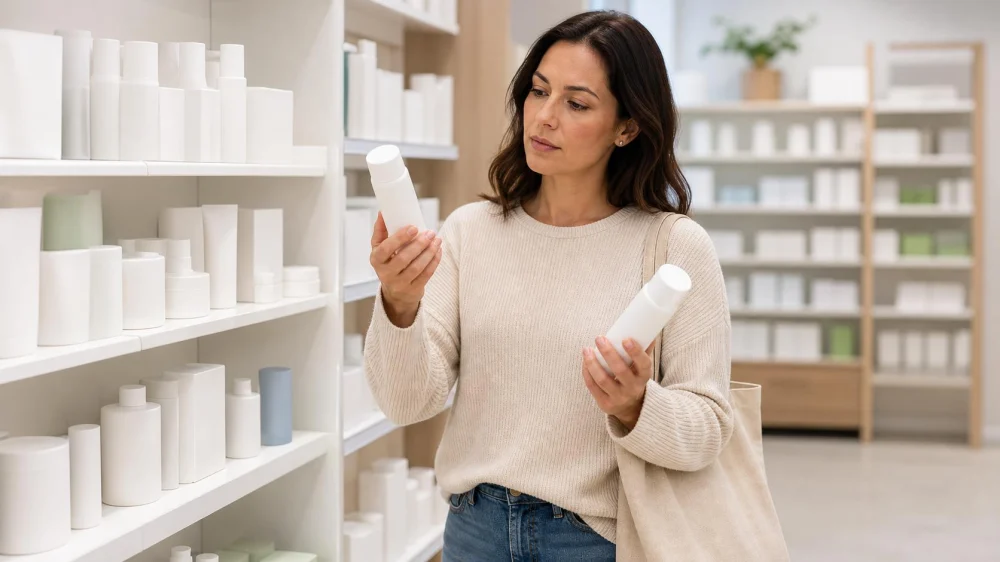
Fragrance-Free vs Unscented Skin Care: Read the Label
On this page
Quick answer
“Unscented” usually means a product has no noticeable smell, but it may contain ingredients that mask another odor. “Fragrance-free” is the more useful starting label when you want to avoid added fragrance. Neither front-label phrase replaces the ingredient list, manufacturer questions, or advice from a qualified healthcare professional when you have a known allergy or recurring reaction.
This guide is for U.S. shoppers comparing cleansers, moisturizers, wipes, and other skin care products. It explains label-reading decisions; it does not diagnose fragrance allergy or guarantee that a product will be tolerated. Any ingredient can be a problem for an individual, and a product without added fragrance can still have a natural raw-material scent.
What the two labels usually mean
“Fragrance-free” and “unscented” answer different questions. Fragrance-free addresses whether fragrance ingredients were added. Unscented addresses whether the finished product has a noticeable scent. A product can therefore smell like almost nothing while still using a masking fragrance, and a fragrance-free product can retain the mild smell of its base ingredients.
The U.S. Food and Drug Administration explains that even some products labeled unscented may contain fragrance ingredients added to cover the unpleasant smell of other materials. FDA consumer information about disposable wipes adds that a fragrance-free cosmetic should not contain ingredients added to create a particular scent, even though the product may still smell like its other ingredients.
There is an important regulatory limitation: the FDA says there is no federal standard or definition governing marketing terms such as “fragrance-free,” “hypoallergenic,” or “for sensitive skin.” Cosmetic labeling still must be truthful and not misleading, but a front-panel claim is not an individualized safety certification.
Use these decision rules:
- Choose fragrance-free over unscented when avoiding added fragrance is the goal.
- Do not judge by smell alone. A faint smell does not prove that fragrance was added, and no smell does not prove that it was absent.
- Read the full ingredient declaration. The front label is a filter, not the entire evaluation.
- Verify unclear claims. Contact the manufacturer using the information on the package when an allergy or past reaction makes the distinction important.
How fragrance appears on an ingredient list
Retail cosmetics generally carry an ingredient declaration. Individual ingredients are usually listed, but a fragrance formula may appear under a collective term such as “fragrance” or “perfume” instead of naming every component. The FDA notes that fragrance formulas can contain complex natural and synthetic mixtures and may be protected as trade secrets.
Begin with the exact ingredient panel on the physical package or current manufacturer page. Look for broad fragrance terms and compare them with any ingredient a healthcare professional has told you to avoid. Do not assume an online retailer's short feature list is the complete declaration.
Essential oils, botanical extracts, and aromatic plant materials deserve the same careful reading. “Plant-based,” “natural,” or “aromatherapy” does not mean fragrance-free or non-allergenic. Some plant-derived materials are included specifically for scent, while others have a different product function but retain an odor. Ask the manufacturer about the purpose of an unclear ingredient rather than guessing from its name.
Also distinguish fragrance from other possible triggers. Preservatives, dyes, metals, rubber-related materials, and active ingredients can cause irritation or allergy in some people. A fragrance-free product is not an allergen-free product and is not automatically suitable for every skin condition.
If a product is both a cosmetic and an over-the-counter drug, such as certain acne treatments or sunscreens, it may have a Drug Facts panel in addition to other labeling. Follow warnings and directions in that panel. Do not use the cosmetic ingredient list to override drug instructions.
A practical shopping checklist
Use the same process each time so marketing language does not replace the facts that matter to you.
- Define the reason for avoiding fragrance. Are you reducing unnecessary scent, following a clinician's plan, avoiding a known ingredient, or investigating recurring irritation? A diagnosed allergy may require more precise avoidance than a general preference.
- Start with the front label. Prefer “fragrance-free” to “unscented.” Treat “gentle,” “clean,” “dermatologist tested,” “hypoallergenic,” and “for sensitive skin” as claims to investigate, not guarantees.
- Read the ingredient declaration. Check for “fragrance,” “perfume,” or another term you have been advised to avoid. Use the package version for the market where you are buying, because formulas can differ by country or change over time.
- Check the product purpose and directions. A rinse-off cleanser, leave-on moisturizer, wipe, and medicated product have different exposure patterns. Confirm where, how often, and how long the product is intended to be used.
- Inspect warnings and packaging. Avoid a damaged seal, changed color, unusual odor, leakage, or missing label. Check any expiration or period-after-opening information provided.
- Ask a specific manufacturer question. Instead of asking only “Is this safe for sensitive skin?”, ask whether any ingredient is included to impart or mask scent and whether the current formula contains the substance you need to avoid.
- Save the details. Photograph the front, ingredient panel, lot number, and purchase date. This record helps if a formula changes or a reaction needs to be discussed.
When shopping locally, compare more than distance. Consider whether staff can answer ingredient questions, whether current labels are visible, whether returns are permitted after an adverse reaction, and whether the location offers access to an appropriately qualified professional. Do not assume a retailer or esthetic service can diagnose an allergy.
How to test and track a new product
A careful label reduces uncertainty but cannot predict every individual response. Introduce one new product at a time so you can connect a change with a result. Keep the rest of the routine stable when practical and record the start date, area of use, and frequency.
The American Academy of Dermatology provides a structured method for testing a skin care product on a small area before broader use. Its guidance recommends using the product on a test spot with the normal amount and duration, repeating the test over several days, and following the product instructions. See the AAD's skin care product testing guidance for the complete process and its limits.
Do not perform a home test with a product that has previously caused a severe reaction or with a substance a clinician has told you to avoid. A consumer spot test is also different from medical patch testing, which is used by clinicians to investigate allergic contact dermatitis.
Track observations with neutral language: itching, burning, redness, swelling, bumps, scaling, eye irritation, breathing symptoms, or no change. Record when the symptom appeared and whether it spread. Photos should be unfiltered and taken in similar light. This information is more useful than labeling your own reaction as an allergy without evaluation.
When professional guidance matters
Professional input is useful when reactions recur, when the trigger is unclear, or when avoiding multiple ingredients has made normal skin care difficult. A medical professional can assess whether symptoms fit irritation, allergy, an existing skin condition, infection, or another cause and decide whether testing or treatment is appropriate.
When choosing a local service, verify the provider type and scope. A product specialist or esthetician may discuss product features and services within their role, but a diagnosis, prescription, or formal allergy evaluation requires an appropriately licensed healthcare professional. Ask who will evaluate you before booking.
Bring the product packaging, ingredient list, start date, use pattern, photos, and a list of other products that touched the area. Mention medicines, allergies, occupation-related exposures, gloves, jewelry, laundry products, and hair products when relevant. Fragrance exposure can come from more than a facial moisturizer.
Important limits and safety notes
If a cosmetic produces an unexpected reaction, stop using it. The FDA advises consumers to contact a healthcare provider and provides a process for reporting cosmetic product problems. Keep the package and identifying details in case the provider, manufacturer, retailer, or FDA needs them.
Seek urgent medical attention for trouble breathing or swallowing, faintness, facial or throat swelling, or other signs of a severe allergic reaction. Severe, rapidly worsening, blistering, infected, very painful, or eye-involving symptoms also need prompt medical guidance. Do not keep retesting a suspected product while symptoms are active.
“Fragrance-free” does not mean odor-free, preservative-free, botanical-free, hypoallergenic, or safe for infants. “Unscented” does not mean the product definitely contains a masking fragrance; it means the absence of a noticeable smell is not enough evidence. Read the current label and verify uncertainties with the manufacturer.
Frequently asked questions
Can a fragrance-free moisturizer still have a smell?
Yes. Base oils, waxes, extracts, and other functional ingredients can have their own odor. The presence of a mild raw-material smell does not by itself prove that a fragrance ingredient was added.
Does unscented mean there is no fragrance?
Not necessarily. FDA explains that some unscented cosmetics contain a small amount of fragrance to mask the smell of other ingredients. Review the ingredient declaration and contact the manufacturer when the distinction matters.
Is “hypoallergenic” better than fragrance-free?
The terms answer different questions, and neither guarantees that an individual will avoid a reaction. FDA states that there is no federal standard defining these front-label claims for cosmetics. Use the ingredient list and your known triggers.
Are essential oils safer than synthetic fragrance?
Natural origin does not establish safety for a particular person. Essential oils and other botanical materials can contain scent components and may irritate or sensitize some users. Consider the specific ingredient and your history rather than using natural versus synthetic as the decision rule.
What information should I save after buying a product?
Keep the product name, ingredient panel, directions, lot number, purchase date, and opening date. If a reaction occurs, also record when you applied it, where you used it, other exposures, symptoms, and clear photos.
Sources and evidence notes
The label distinctions and U.S. regulatory limits in this article are based on FDA consumer resources about fragrances in cosmetics, cosmetic allergens, and disposable wipes. The product-testing boundary is aligned with AAD guidance. Formulas, labels, and individual reactions vary, so confirm the current package and seek qualified medical advice for personal health decisions.
Conclusion and next steps
When choosing between two otherwise suitable products, “fragrance-free” is generally the more useful label for avoiding added fragrance, while “unscented” mainly describes the lack of a noticeable smell. Make the final decision with the ingredient declaration, directions, manufacturer answers, and your own documented history. Introduce one product at a time, stop after an unexpected reaction, and seek professional help when symptoms are severe, recurrent, or hard to explain.

 La Bella Salon Suites4.0 (4 reviews)
 Monica Ryan Skincare0.0 (0 reviews)
 Del Carmen Skin & Beauty5.0 (11 reviews)
 Renee Aesthetics5.0 (8 reviews)
 Gmirka Luxury Skin Care5.0 (85 reviews)
 Alluring Aesthetics By Amber5.0 (15 reviews)
 The Best Skin Care Routine for Your 20s: What You Need to Know
 Natural Remedies For Your Age Spots With These 7 Tips
 Expert Advice on Puffy Eyes with a Simple Routine | Effective Eye Care Tips
 Daily Skin Care Routine For Dry Skin | Simple and Effective Tips
 Effective Tips for Sensitive Skin with Redness in Teens
 How To Detoxify Physical Exfoliants For Large Pores Skin