
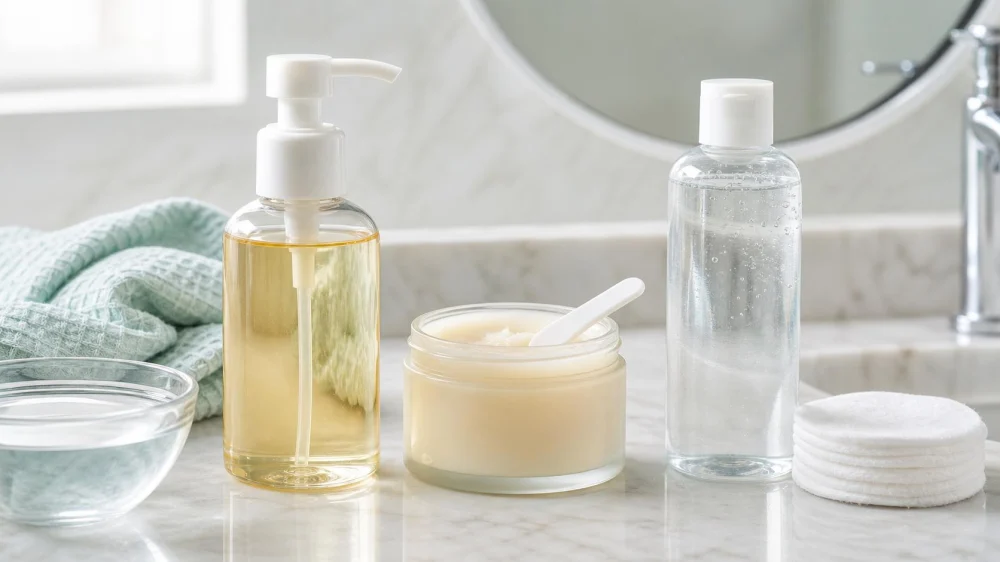
Cleansing Oil, Balm, or Micellar Water: Which Fits?
On this page
Quick answer
Choose cleansing oil or balm when you want to dissolve water-resistant sunscreen or heavier makeup with minimal wiping, provided the product emulsifies and rinses comfortably. Choose micellar water for lighter removal or travel when a cotton pad is practical. Follow the label, rinse when directed, and use a gentle cleanser afterward only if residue or makeup remains.
This guide is for adults in the United States choosing a nonprescription facial cleansing product. Acne, eczema, rosacea, allergies, eye disease, and prescription treatment can change what is appropriate.
What these cleansers do
Makeup, sunscreen, skin oil, and environmental residue contain different mixtures of water-soluble and oil-soluble materials. Removal products use oils and/or surfactants to loosen them so they can be lifted or rinsed away.
- Cleansing oil: A liquid oil-based formula that is usually massaged onto dry skin and emulsified with water before rinsing.
- Cleansing balm: A solid or semi-solid oil-based formula that melts during use and often emulsifies like an oil cleanser.
- Micellar water: A water-based surfactant solution used with a soft pad to lift residue from the skin.
The category name does not predict every ingredient or result. Fragrance, preservatives, emulsifiers, botanical extracts, cleansing strength, and eye compatibility vary by product.
Compare oil, balm, and micellar water
Cleansing oil is best for spreading quickly over a large area and dissolving tenacious face products. It can be less convenient for travel and may leak. A well-formulated oil cleanser should emulsify as directed rather than requiring hard rubbing.
Cleansing balm is best for controlled use and travel-friendly texture. It can work well on long-wear makeup, but jars require clean hands or a clean spatula, and thick residue can be uncomfortable if the formula does not rinse well for you.
Micellar water is best for light makeup, quick correction, or limited sink access. It uses repeated pad contact, which can irritate skin or eyelids when users scrub. Some formulas are designed to remain on skin; others should be rinsed, so read the label.
None is automatically best for oily, dry, sensitive, or acne-prone skin. The useful product removes what you wear without burning, swelling, persistent tightness, clogged-feeling residue, or repeated friction.
Choose by your actual use case
- Water-resistant sunscreen: Start with an emulsifying oil or balm when a gentle water-based cleanser alone leaves a film.
- Heavy or long-wear makeup: Oil or balm can reduce wiping; use a dedicated eye product if the face cleanser is not approved for the eye area.
- Light makeup: Micellar water may be sufficient when the label permits and removal is complete without scrubbing.
- Travel or backstage use: Balm reduces spill risk; micellar water is convenient but creates pad waste and still needs hygienic handling.
- Very dry or reactive skin: Choose fragrance-free, gentle formulas with the fewest known personal triggers and avoid over-cleansing.
- Acne-prone skin: Look for products labeled non-comedogenic or unlikely to clog pores, then judge your own response over time.
- Eyelash extensions or eye conditions: Follow the extension provider, eye clinician, and product instructions because oils, surfactants, and rubbing may create problems.
Do not buy a second cleanser solely because “double cleansing” is popular. Add a gentle wash only when the first step does not fully remove residue or when the product directs it.
Remove makeup and sunscreen gently
- Wash and dry your hands.
- Remove contact lenses first when your eye-care professional or product instructs.
- Use the amount and application surface specified on the label.
- For oil or balm, spread with fingertips and allow time to loosen product without prolonged massage.
- Add water to emulsify when directed, then rinse with lukewarm water.
- For micellar water, saturate a soft pad enough to glide and hold briefly over makeup rather than scrubbing.
- Rinse or follow with a gentle cleanser when the label requires it or residue remains.
- Pat dry with a clean towel and apply moisturizer when your skin needs it.
The American Academy of Dermatology recommends gentle fingertip cleansing with lukewarm water and avoiding scrubbing. Repeated friction is not proof that a product is working better.
Cleanser decision checklist
- What exactly must be removed?
- Is the formula approved for the eye and lip areas you plan to use it on?
- Does it contain a known fragrance, preservative, or botanical trigger?
- Does the label require dry skin, wet skin, emulsification, pads, or rinsing?
- Can it remove product without rubbing?
- Does skin feel comfortable after rinsing rather than tight, burning, or coated?
- Is a second gentle cleanse actually needed?
- Can the packaging be kept clean and closed?
- Will the routine be practical enough to use consistently?
Best for a minimalist routine: one gentle cleanser that fully removes your daily products. Best for resistant makeup: a dedicated removal step followed only as needed. Not ideal: stacking multiple cleansers until skin feels “squeaky.”
Limitations and important notes
This article cannot predict irritation, allergy, acne, or eye tolerance. Stop using a product that causes persistent burning, swelling, hives, blistering, worsening rash, or eye pain, and seek appropriate medical care.
Rinse the eye promptly according to product and poison-control guidance after accidental exposure. Urgent eye pain, vision change, significant swelling, breathing difficulty, or widespread allergic symptoms need prompt medical evaluation.
Patch testing a cosmetic on a small area may reveal obvious irritation but does not guarantee that full-face or eyelid use will be safe. People with a history of contact allergy or serious skin disease should ask a dermatologist about testing and product selection.
Frequently asked questions
Does cleansing oil make oily skin oilier?
Not necessarily. Formula, emulsification, rinsing, total routine, and individual response matter more than the word “oil.” Stop or change products if residue or breakouts persist.
Do I need to rinse micellar water?
Follow the product label. Rinsing can also help when residue, stinging, or sensitivity occurs, but eye-area instructions may differ.
Is a balm more moisturizing than an oil?
Texture alone does not determine the after-feel or barrier effect. Compare the full ingredient list, rinsability, and your skin response.
Must I double cleanse every night?
No. Use the least cleansing needed to remove sunscreen, makeup, and soil comfortably. A second gentle cleanser is useful only when needed.
Can I use the same product around my eyes?
Only if the label permits eye-area use and it does not conflict with contact lens, extension, or medical guidance. Stop for burning, pain, or vision change.
Sources and evidence notes
The gentle cleansing, lukewarm water, fingertip application, makeup removal, and no-scrubbing principles in this guide reflect current American Academy of Dermatology advice. Format comparisons are based on common cosmetic formulation and use patterns; individual products vary.
Conclusion and next steps
List what you remove most nights and how much wiping your current method requires. Choose oil or balm for resistant products and micellar water for lighter removal or limited sink access, then follow the exact label. Keep the routine only if it removes fully without burning, tightness, residue, or repeated friction.



 Sisters Beauty0.0 (0 reviews)
 Facial Bar Redondo Beach0.0 (0 reviews)
 Milan Medical3.0 (20 reviews)
 Feed Your Skin0.0 (0 reviews)
 Forever You Aesthetics5.0 (22 reviews)
 Skin Savior New York5.0 (12 reviews)
 The Best Face Serums for Hydration, Anti-Aging, and Skin Repair Guide
 The Best Skin Care Products for Treating Rosacea and Redness
 Expert Advice on Puffy Eyes in People Over 40
 Best Skin Care Tips for Managing Oily Skin Without Drying Out
 Everything You Need To Know About Dark Circles For People Living In Dry Climates | SkinCare Experts
 How to Improve Oily Skin with Chemical Exfoliants | SkinCare Experts