
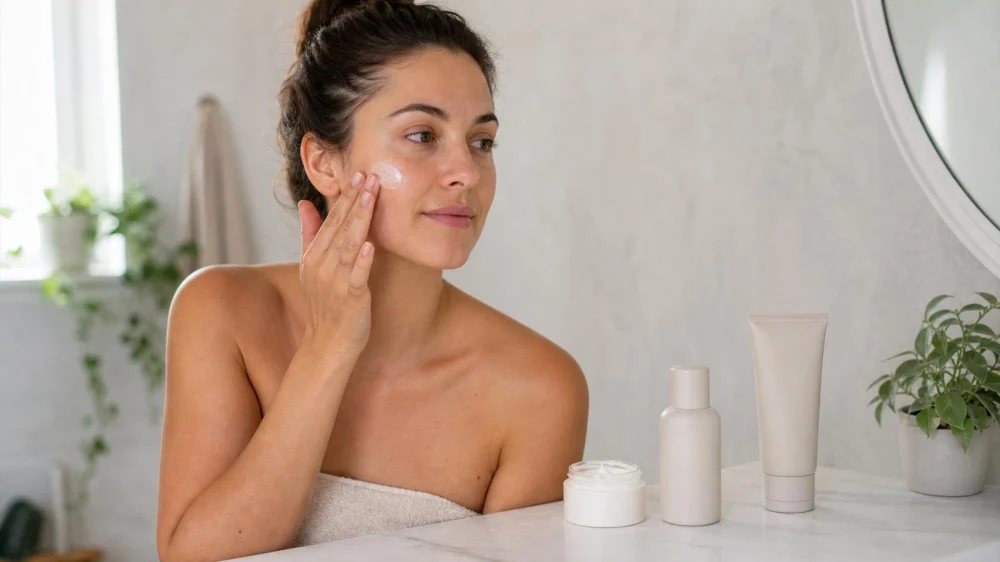
What Is the Skin Barrier? Build a Simpler Support Routine
On this page
- Quick answer
- What the skin barrier is
- Signs that deserve a routine review
- Common barrier stressors
- Build a simple support routine
- Choose a moisturizer by function
- Reintroduce optional products slowly
- Adjust for environment and daily habits
- Limitations and professional-care triggers
- Frequently asked questions
- Sources and evidence notes
- Conclusion and next steps
Quick answer
The skin barrier is the outer protective layer that helps keep water in and irritants, allergens, and microbes out. Support it with gentle cleansing, a compatible moisturizer, sun protection, and fewer unnecessary products. When skin suddenly stings, feels persistently tight, flakes, or reacts to products that were previously comfortable, pause new actives and review the routine rather than adding more treatments.
This guide is for adults building a basic skincare routine in the United States. Symptoms can have many causes, and persistent, severe, spreading, infected-looking, or painful changes need evaluation by a qualified healthcare professional.
What the skin barrier is
The skin barrier is primarily the outermost epidermal layer that limits water loss and protects underlying tissue from the outside environment. It is often compared to bricks and mortar: mature skin cells provide structure while lipids help seal the spaces between them.
The barrier is not a separate coating that can be permanently “sealed.” It is living tissue that continually renews and responds to cleansing, climate, friction, inflammation, medications, and health. A routine can support normal function, but a cosmetic product cannot diagnose or cure every cause of irritation.
Signs that deserve a routine review
- persistent tightness after washing;
- new stinging or burning when familiar products are applied;
- roughness, flaking, or small surface cracks;
- redness or uneven irritation after increasing active products;
- greater sensitivity to wind, dry air, shaving, or friction;
- makeup or sunscreen applying unevenly over dry patches.
These observations are not a diagnosis. Eczema, allergic contact dermatitis, infection, acne treatments, rosacea, medication effects, and other conditions can overlap. Avoid labeling every rash as a “damaged barrier.”
Common barrier stressors
A routine can become irritating when several individually tolerable steps combine. Common contributors include:
- frequent cleansing or very hot water;
- scrubs, brushes, rough towels, picking, and repeated friction;
- using multiple exfoliating acids, retinoids, acne drugs, or strong treatments at once;
- introducing several new products together;
- fragrance or another ingredient that causes irritation or allergy;
- dry indoor air, cold wind, heat, sweating, masks, or occupational exposure;
- changing prescription treatment without guidance.
The most useful question is not “Which ingredient is strongest?” It is “Which recent change or repeated exposure fits the timing and location of the problem?”
Build a simple support routine
- Pause optional new actives. Stop recently added exfoliants, scrubs, strong masks, or other nonessential products that sting, unless a clinician has directed their use.
- Cleanse gently. Use lukewarm water and a mild compatible cleanser only as often as needed for sweat, sunscreen, makeup, or soil.
- Pat rather than rub. Leave skin slightly damp if that makes the moisturizer comfortable.
- Apply a simple moisturizer. Choose a fragrance-free option when fragrance is a concern and avoid formulas that cause burning.
- Protect from ultraviolet exposure. Use shade, clothing, and a tolerated broad-spectrum sunscreen as appropriate.
- Track the response. Record products, timing, symptoms, and photos in consistent lighting if a clinician may need them.
If a prescribed product is causing trouble, contact the prescriber before changing the schedule. A clinician may adjust strength, frequency, application order, or diagnosis.
Choose a moisturizer by function
Moisturizers often combine three functional groups:
- Humectants help attract and hold water in the outer skin.
- Emollients smooth spaces between surface cells and improve feel.
- Occlusives reduce water loss by forming a more protective surface layer.
Lotions are often lighter, while creams and ointments are generally more occlusive, but formulas vary. Choose by body area, climate, tolerance, and how dry the skin is. A heavier product may suit dry hands or patches but feel uncomfortable on acne-prone facial areas.
“Natural,” “clean,” “dermatologist tested,” or “hypoallergenic” language does not guarantee compatibility. Read the actual ingredient list and patch-test cautiously when appropriate.
Reintroduce optional products slowly
Wait until the skin feels stable, then add one optional product at a time. Use it less frequently than the maximum label schedule at first when the product allows, and keep the rest of the routine unchanged. Follow drug labels and prescription instructions exactly.
Record the date, amount, application area, and response. Stop and seek guidance for swelling, hives, blistering, severe pain, breathing difficulty, or a rapidly spreading reaction. Do not repeatedly “push through” significant burning in the hope that skin will adapt.
Adjust for environment and daily habits
- Use gloves and protective practices for wet work or irritating workplace exposure.
- Change out of sweaty clothing and cleanse gently after activity.
- Reduce friction from tight wearables, straps, masks, or repetitive rubbing.
- Use humidification safely if indoor air is very dry, following device cleaning guidance.
- Apply hand moisturizer after washing when tolerated.
- Do not share open jars, applicators, or products that contact irritated skin.
Barrier support is often a consistency problem rather than a product-collection problem. A short routine used reliably is easier to evaluate.
Limitations and professional-care triggers
Seek professional evaluation for persistent symptoms, recurrent rash, facial or eye swelling, blisters, open sores, pus, spreading warmth, fever, severe pain, or involvement of eyes, mouth, or genitals. Call emergency services for breathing difficulty or signs of a severe allergic reaction.
Children, pregnant people, people receiving cancer treatment, and those with immune, skin, or other medical conditions may need individualized product and medication guidance. Do not use someone else’s prescription cream.
Frequently asked questions
Can the skin barrier be repaired overnight?
Comfort may improve quickly after removing an irritant, but skin recovery varies with cause and severity. Avoid products promising a guaranteed overnight repair.
Should I stop washing my face?
Not necessarily. Use gentle cleansing suited to sunscreen, makeup, sweat, and skin needs. Over-cleansing and failing to remove irritants can both create problems.
Are ceramides required?
Ceramides are skin lipids used in many moisturizers, but no single ingredient is required for every person. Overall formula and tolerance matter.
Why does moisturizer sting?
Irritated skin can sting, or an ingredient may not suit you. Stop a product that causes significant burning and seek advice if symptoms persist or worsen.
Sources and evidence notes
This guide reflects broad dermatology and skincare principles: the outer epidermis limits water loss and environmental entry, gentle cleansing and moisturization support function, and excessive irritation can worsen symptoms. Product response and skin disease require individual assessment.
Conclusion and next steps
Simplify to gentle cleansing, a comfortable moisturizer, and appropriate sun protection, then stop changing several variables at once. Track what stings, flakes, or improves. Reintroduce optional products one at a time only after skin is stable, and seek professional care when symptoms are severe, persistent, spreading, or inconsistent with a simple routine problem.


 The Vanity Center LLC4.0 (26 reviews)
 Skin Laundry - Park Meadows4.0 (144 reviews)
 Radiant Glow Skin Care5.0 (1 reviews)
 Epidermis Esthetics Lab5.0 (13 reviews)
 Kofa Self Skin Care0.0 (0 reviews)
 Skin Sense Body Balance5.0 (10 reviews)
 How to Repair Skin Damage from Pollution with Skin Care Products
 How to Use Hyaluronic Acid for Fine Lines and Skin Care Treatment
 The Ultimate Guide to Finding the Right Moisturizer for Your Skin
 Skin Care Tips For Dry Skin Effectively
 Understanding Sun Damage For Women: Causes, Effects, and Prevention Tips
 Natural Remedies For Scars: What You Need To Know