
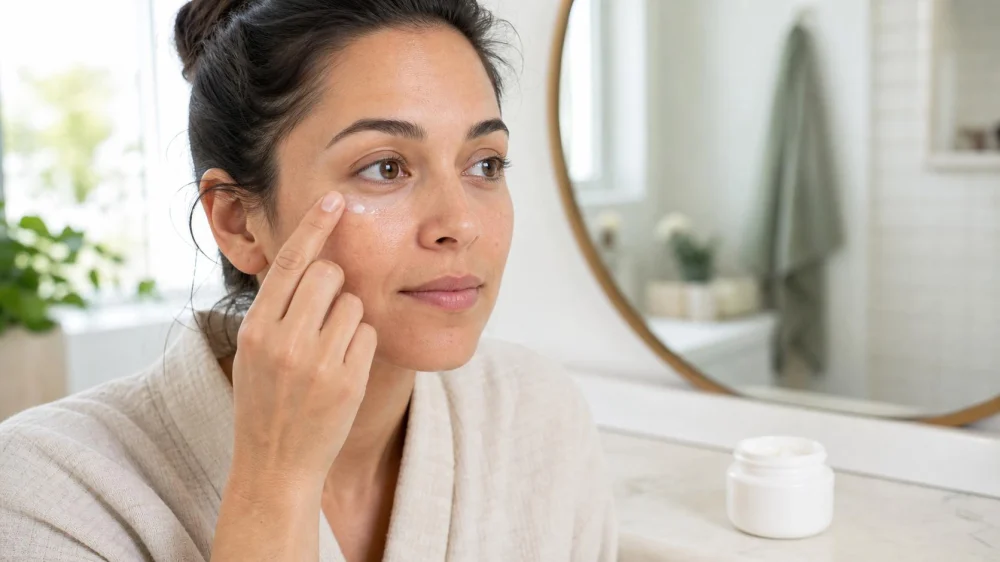
Skin Care Around the Eyes: A Product Safety Checklist
On this page
- Quick answer
- Why the eye area needs different judgment
- Read the intended-use label
- Apply with clean, controlled technique
- Respond to irritation or eye exposure
- Know when professional help is best
- Eye-area product checklist
- Limitations and important notes
- Sources and evidence notes
- Frequently asked questions
- Conclusion and next steps
Quick answer
Use a skin-care product around the eyes only when its label permits that area. Wash hands, use the directed amount, keep product away from the eye surface and lash line unless specifically intended there, and add one new item at a time. Stop for burning, swelling, or rash; rinse accidental eye exposure as directed and seek help for pain or vision changes.
Why the eye area needs different judgment
“Eye area” may refer to the skin below the eye, eyelids, lash line, or the eye itself, but these are not interchangeable treatment areas. Thin skin, frequent movement, tears, contact lenses, and proximity to the eye surface make migration and irritation important.
A product safe on the cheek is not automatically suitable for eyelids. Creams, cosmetics, sunscreens, acne treatments, retinoids, acids, fragrances, lash products, and prescription medicines have different directions and warnings.
Read the intended-use label
- Confirm whether the product is intended for facial skin, eyelids, lashes, or another specific area.
- Read warnings about eye contact, broken skin, contact lenses, pregnancy, sun exposure, and combining products.
- Check the amount, frequency, and whether rinsing is required.
- Inspect the seal, expiration or period-after-opening information, odor, color, and texture.
- Do not use a tester, shared applicator, or product with a contaminated tip.
- Follow prescription directions rather than a cosmetic routine found online.
Terms such as “ophthalmologist tested,” “gentle,” or “clean” do not guarantee that every user will tolerate a product or that it is safe on every eye-area surface. The full directions matter.
Apply with clean, controlled technique
- Remove contact lenses if the product or eye-care professional instructs you to.
- Wash and dry hands.
- Dispense a small directed amount without touching the container tip to skin.
- Dot or spread gently on the permitted skin; do not rub or stretch the eyelid.
- Keep the product out of the eye and away from the lash line unless labeled for that use.
- Allow layers to settle as directed before applying another product or makeup.
- Wash reusable applicators at the recommended interval and store products closed.
Introduce one new product at a time. A patch test may help identify some skin reactions when the label recommends it, but it cannot prove that a product will be safe next to the eye or prevent all delayed reactions.
Respond to irritation or eye exposure
For mild skin irritation, stop the suspected product, avoid rubbing, and simplify the routine. Do not apply acids, essential oils, steroid creams, antibiotic ointments, or leftover eye drops unless a qualified clinician directs them for this problem.
If product enters the eye, follow its first-aid label. Common instructions may include prompt rinsing with clean lukewarm water, but product-specific directions control. Remove contact lenses only when they come out easily and the instructions permit it.
Seek urgent medical or eye-care help for significant eye pain, vision change, light sensitivity, chemical exposure, inability to open the eye, persistent redness, marked swelling, blistering, or symptoms that continue after appropriate rinsing. Trouble breathing or severe allergic symptoms require emergency care.
Know when professional help is best
A dermatologist can assess eyelid skin disease and product allergy; an optometrist or ophthalmologist can examine the eye surface and vision. Primary care or urgent care may help route time-sensitive symptoms. Choose based on whether the problem is mainly skin, the eye itself, or a severe reaction.
When comparing local services in the United States, verify professional licensing through the appropriate state source, ask whether the clinician evaluates the specific concern, and confirm urgent access and insurance details. A directory listing or review is not a clinical endorsement.
Eye-area product checklist
- Confirm the exact permitted area
- Read eye-contact and contact-lens warnings
- Use clean hands and the directed amount
- Keep ordinary facial products away from the eye surface
- Add one new product at a time
- Stop rather than layering over irritation
- Follow the label for accidental exposure
- Escalate pain, vision change, or severe swelling promptly
Limitations and important notes
This guide cannot diagnose allergy, infection, dry eye, eyelid inflammation, or another condition. Photos and symptom descriptions cannot rule out eye-surface injury. Children and people with eye surgery, eye disease, immune suppression, or prescription eye treatment need individualized advice.
Cosmetic products are not substitutes for prescribed eye or skin medicines. Do not place a product into the eye unless it is specifically formulated, labeled, and directed for ocular use.
Sources and evidence notes
The safety approach reflects broad dermatology and eye-care practice: use products only on intended areas, reduce contamination, avoid rubbing and unapproved treatments, rinse exposures according to directions, and escalate eye pain or vision change. Product labels and licensed clinicians provide the specific guidance.
Frequently asked questions
Can I use my face moisturizer on my eyelids?
Only if its directions permit eyelid use and you tolerate it. “For face” does not necessarily include the mobile eyelid or lash line.
Does a patch test make eye-area use safe?
No. It may reveal some skin sensitivity but cannot test accidental eye contact, migration, contamination, or every delayed reaction.
Can I keep using a product if it only tingles briefly?
Do not assume tingling is proof of effectiveness. Follow the label and stop for burning or irritation. Ask a clinician if the intended sensation is unclear.
Should I use leftover eye drops for irritation?
No. Different drops treat different problems, may be expired or contaminated, and can mask symptoms. Use only current directions from an eye-care professional.
Conclusion and next steps
Define the exact area, read the label, and apply a small directed amount with clean hands. Keep ordinary skin products out of the eye and change only one routine variable at a time. Stop when irritation appears, and seek urgent evaluation for eye pain, vision change, major swelling, or persistent symptoms.




 SeeBeyond Beauty4.0 (60 reviews)
 LISA LVSkincare5.0 (29 reviews)
 Angel Hands Skin Care5.0 (22 reviews)
 Nicole's Skin Care4.0 (11 reviews)
 Piedmont Plastic Surgery & Dermatology4.0 (2086 reviews)
 Andrea Minor Skin Care5.0 (7 reviews)
 How To Treat Dry Skin In Teens With Effective Daily Care
 Skin Care Tips for Treating Scars with Eye Creams
 How to Detoxify Sunscreen for Wrinkle-Free Skin | SkinCare Experts
 Natural Remedies for Wrinkles: Effective Solutions to Achieve Younger-Looking Skin
 How to Achieve a Youthful Glow with the Best Anti-Aging Skin Care Tips
 The Best Skin Care Products for Soothing and Calming Your Skin